
The biggest SEO problem in 2026 isn’t finding keywords.
It’s finding keywords your competitors never think to target.
That’s what niche keyword research solves.
Niche keyword research is about finding highly specific, low-competition search terms that target a narrow audience, instead of going neck-to-neck with larger players for broad head terms. (To get started with niche keyword research right away, check out our page on keyword research)
“Niche” in keyword research can imply one of the four specifics:
- Niche topic to cover a narrow subject vertical
- Niche audience to cater to a narrow Ideal Customer Profile (ICP)
- Niche product for a highly specialized product offering
- Niche geography to target a specific service area.
This blog narrows down on niche audiences to serve a specific ICP, and the same procedure can be applied across the remaining subjects.
As your audience narrows, keyword research gets harder. Traditional keyword research workflows weren’t built for this level of specificity.
Manual niche keyword research quickly becomes repetitive. You gather seed terms, validate search volume, compare SERPs, cluster related queries, and finally judge commercial intent. Most of those steps can now be automated.
So, the same workflow that takes hours of work now runs in 3 minutes when you hand these steps to an AI powered platform which runs them for you. It’s time to say goodbye to the old manual research and improve accuracy by a long shot.
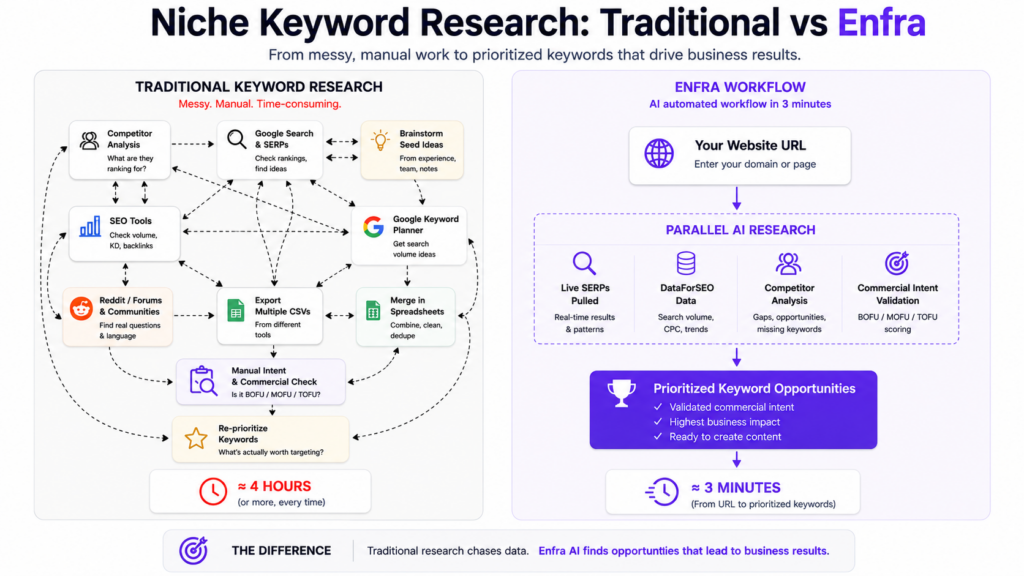
Why niche keyword research matters more in 2026 than ever
LLMs like ChatGPT and Claude now have a significant amount of context behind a user’s query. With the improvements in their user-level memory, they now know your company, industry, team size, specific challenges, budget or time constraints, and much more. AI powered answer engines use this context to run detailed query fan-outs, and then provide extremely specific answers.
As AI Overviews increasingly answer broad informational queries directly on the SERP, click-through opportunities have shifted further down the funnel. At the same time, users are searching with greater specificity, and those searches tend to convert better.
So, as search queries become longer and more specific, conversion rates increase significantly. According to Neil Patel’s study of 40 companies, conversion rates rise from 0.17% for one-word keywords to 1.94% for six-word keywords.
The implication is clear: commercial intent is your shield, “niche” keywords are your pillars, and AI automation is the bridge that connects the two. The rest of the guide helps you navigate through this bridge.
What the workflow is doing (and why it works):
Four ideas worth understanding first
Before we jump into the workflow, here are four concepts that explain why it works:
- Why commercial intent prioritised over volume:
30/mo BOFU converts higher than 1,000/mo TOFU. The narrow audience has already self-selected. The 3-minute workflow sorts by intent tier because the same volume produces a very different pipeline depending on which tier the terms sit in. - Why low-KD terms matter for narrow ICPs:
KD measures the SERP’s link profile strength, not just competition density. A KD 12 term at 40/mo BOFU has a much higher chance of ranking than a KD 45 term at 1k/mo TOFU. Niche BOFU SERPs are typically held by small vendor pages and forums, not high-DR editorial sites that dominate TOFU SERPs.
The 3-minute workflow surfaces low-KD, intent-rich terms preferentially because those are the terms where ranking effort converts to pipeline. - Why cluster grouping matters:
A single keyword tells you whether your content can rank for that one term. A cluster tells you whether your page can rank for the set of related queries. A page targeting “soc 2 audit checklist for fintech” should also target “soc 2 type 2 timeline for early-stage”. Same reader but at different buying-stages. - Why intent + conversion angle, not just intent label:
BOFU + transactional signals purchase mode. MOFU + commercial signals comparison mode. The conversion angle determines content format (BOFU transactional wants a product page or comparison; MOFU commercial wants a buying guide).
The 3-minute Enfra workflow
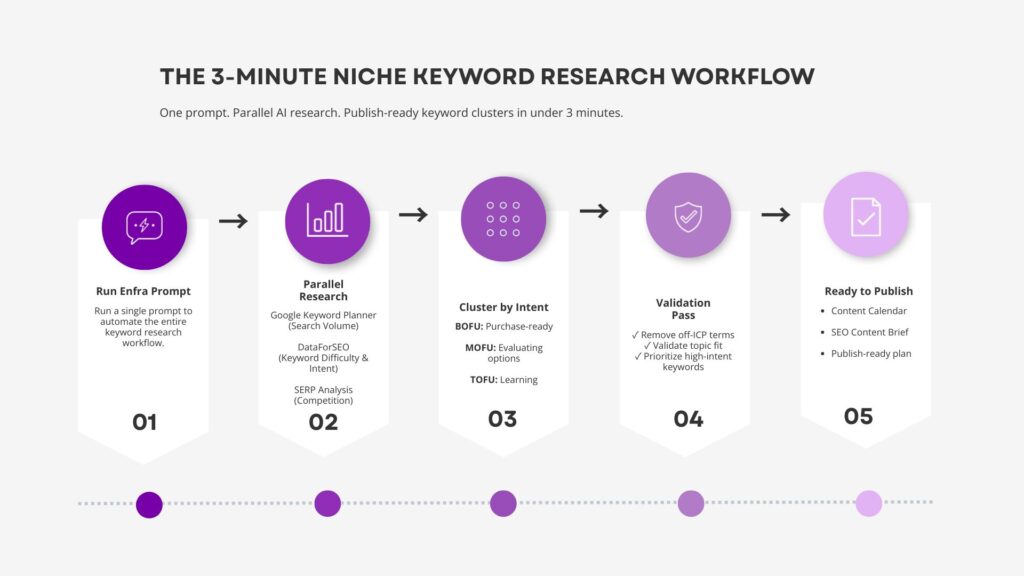
Step 1: Log in to Enfra
Step 2: Run the keyword research prompt:
“Run niche keyword research on [URL]. Pull Google Keyword Planner volume + SERP analysis. Cluster the results by intent, volume tier (high/mid/low), and KD bucket. Tag each cluster with BOFU/MOFU/TOFU intent and the conversion angle.”
Step 3: Read the clustered output: 30–60 terms across 4–6 intent clusters, with volume + KD + intent probability per term.
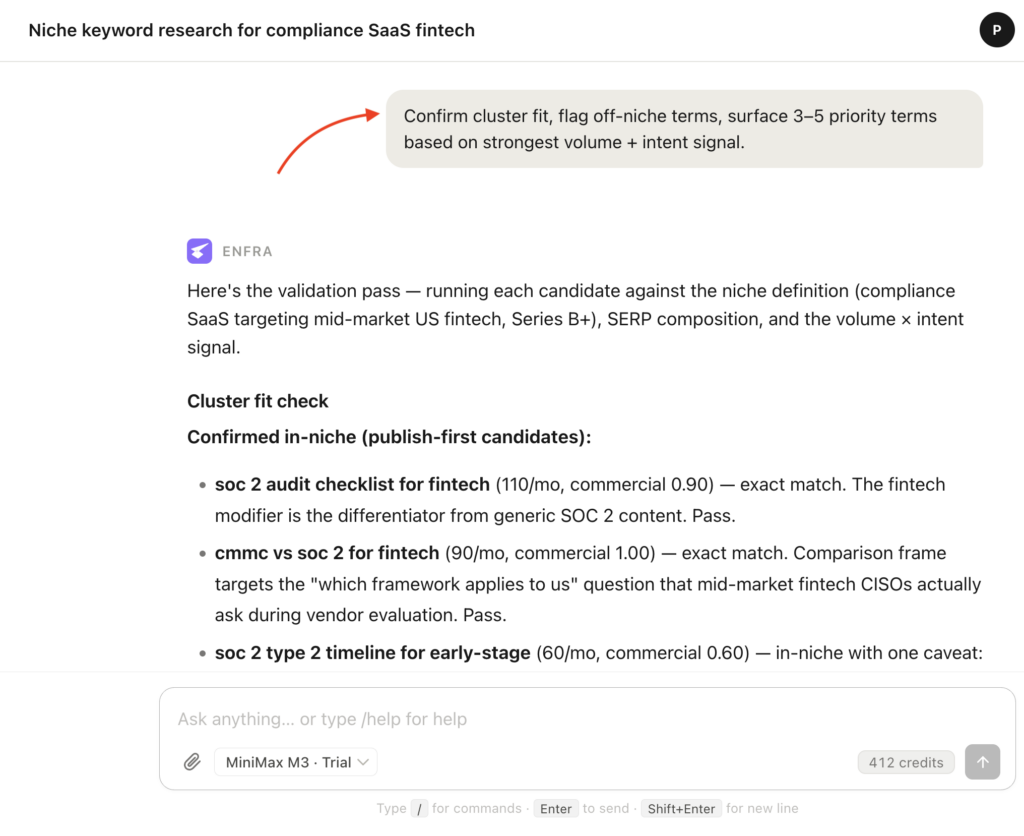
Step 4: Ask Enfra to confirm cluster fit, flag off-niche terms, surface 3–5 priority terms based on strongest volume + intent signal.
Step 5: Export to your content calendar, or push to SEO content brief to start the brief workflow.
Once Enfra returns the clustered keywords, use the following framework to decide which clusters deserve your attention first:
| Cluster type | Typical intent | Recommended content | Typical priority |
|---|---|---|---|
| BOFU (transactional) | Ready to buy | Product page, comparison, demo | Highest |
| MOFU (commercial) | Evaluating options | Buying guide, alternatives, comparison | High |
| Long-tail BOFU | Highly specific purchase intent | Landing page, use case, checklist | High |
| TOFU (informational) | Learning | Educational blog, glossary, explainer | Lower |
Real-world example: compliance SaaS for mid-market fintech
Sample niche: “compliance software for mid-market fintech.”
Step 1: Paste the prompt
“Niche keyword research for compliance SaaS targeting mid-market fintech (Series B+, regulated US fintech). Pull Keyword Planner volume, DataForSEO KD, SERP intent classification. Cluster by intent, surface 5 priority terms.” into Enfra.
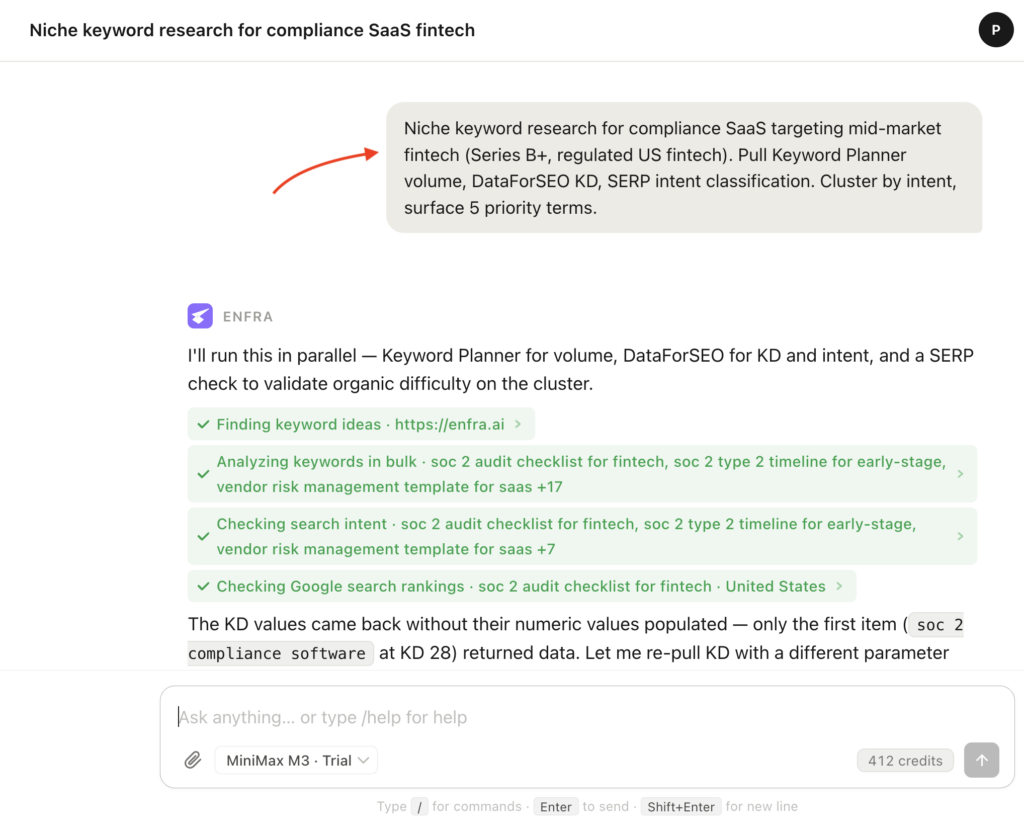
Enfra’s first move is to state the plan before executing it: “I’ll run this in parallel — Keyword Planner for volume, DataForSEO for KD and intent, and a SERP check to validate organic difficulty on the cluster.”
That’s AI handling multiple manual workflows in parallel within a single session.
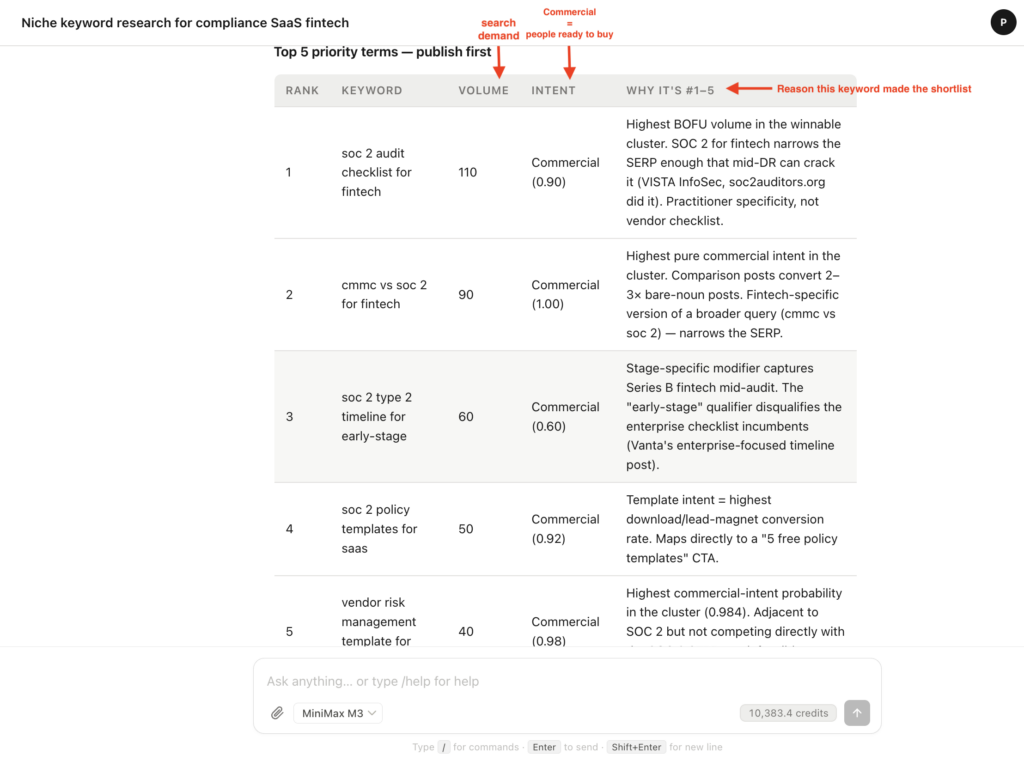
Interpretation of Enfra’s output
Enfra runs 1) Keyword Planner, 2) DataForSEO, and 3) a SERP check in parallel, then returns a clustered set of keywords spanning BOFU, MOFU, and TOFU intent, each one tagged with volume, a commercial-intent score, and a read on the SERP itself, not just a difficulty number.
The last column is where the shortlist starts to make sense. Instead of ordering keywords by search volume alone, Enfra explains why each one deserves a place in the final list.
- The first recommendation, “SOC 2 audit checklist for fintech,” earns the top spot because it combines healthy search demand with a SERP that’s still open to well-targeted content. Established vendors like Vanta appear prominently, but practitioner-focused articles continue to rank by answering fintech-specific questions in more depth than generic vendor pages.
- The second recommendation, “CMMC vs SOC 2 for fintech,” highlights another opportunity. Comparison keywords usually signal that buyers are actively weighing solutions, and narrowing the topic to fintech creates a much more focused search landscape than the broader query.
- The remaining three recommendations follow the same principle. “SOC 2 Type 2 timeline for early-stage,” “SOC 2 policy templates for SaaS,” and “Vendor risk management template” aren’t the biggest keywords in the space, but they solve highly specific problems for people already moving through the compliance journey. Those are often the searches where focused, well-researched content can outperform larger competitors.
Step 2: Paste the confirmation prompt
“Confirm all 5 terms fall inside the ‘mid-market regulated US fintech’ ICP. Flag any that leak into enterprise or early-stage audiences.”
Interpretation of Enfra’s output
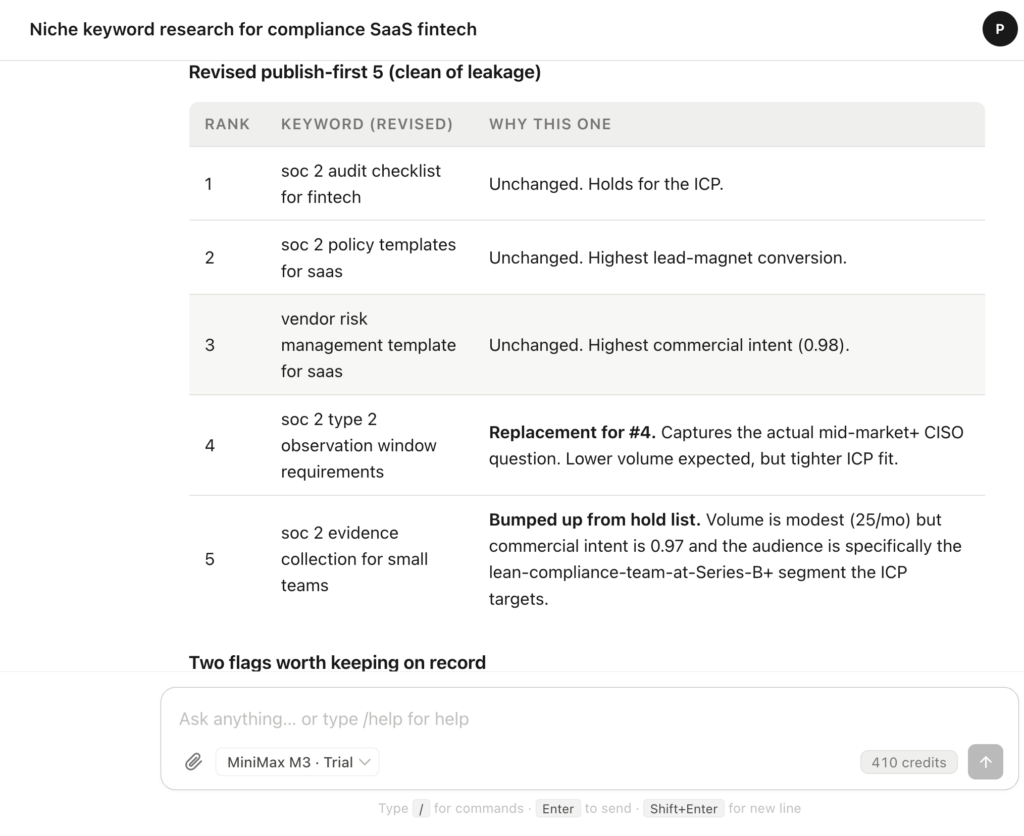
Here’s how the confirmation prompt changed the output:
- Three terms maintained their position,
- Two had moved down,
- One moved toward an enterprise/defense-contractor audience and got demoted to a footnote, and
- The other moved toward earlier-stage companies through its own wording, so it was swapped for a more precisely worded alternative, at somewhat lower volume, but the actual question a mid-market compliance lead asks.
Final output
Every term on the revised list is a checklist, template, or specific technical requirement: a direct effect of screening for BOFU intent over informational volume. If you’re building a broader content plan around this kind of narrow, product-led targeting, that structure is covered in our guide to product-led SaaS SEO.
Manually, this same process means pulling volume by hand, checking SERPs term by term, and holding an ICP definition in your head well enough to catch leakage in a term that scores well on intent alone. That’s the hours long manual work, and the validation pass is the first thing to get skipped when you’re doing it by hand.
Going beyond the 3-minute workflow
You need to get started somewhere, and the 3 minute workflow is what helps you get the ball rolling. Full publish-ready work requires your human intent just as much as it requires AI automation. This spans out into 4 layers, 3 of which Enfra easily handles –
- Customer-data extraction: This involves pulling seed terms from sources that no SEO tool has access to – CRM transcripts, support tickets, sales call recordings, win/loss notes, onboarding survey free-text fields. This is human work: someone has to read the transcripts and pull the recurring phrase patterns.
The reason this layer matters more is it helps you pin down the exact language your target customers use. For example, a fintech CTO doesn’t search for a “vendor risk management platform.” She searches “how to track vendor risk in excel for SOC 2.” Tool-first research misses the second form. Customer-data-first research surfaces it.
Tools like Otter, Gong, or Chorus surface seed phrases when you search transcripts; Zendesk, Intercom, or Help Scout surface them when you tag and export support tickets by topic. These are the customer’s input tools. The workflow validates the seeds you pull from these sources, but the human extraction is yours to do. - Competitor gap analysis: You can run 5-10 direct competitors through Enfra’s competitor SEO analysis and surface the three gap categories: terms they rank for that you don’t (highest priority), terms they rank for that don’t match their product (often winnable), and terms with visible volume that nobody ranks for yet (harder to spot, higher upside).
- SERP feature check: Check which terms in the cluster are likely to surface AI-generated answers before you commit content to them. Skip terms where AI-generated answers cannibalize the click. Prioritize terms where the SERP is still organic-driven. Enfra’s tracking surface flags this in the validation pass.
- Content brief generation: Turn the cluster into a publish-ready brief via Enfra’s content brief workflow. The brief covers word count, structure, internal links, citation list, schema, and the conversion target.
That’s the full 25-minute version spanning across 4 layers – a very simple walkthrough to full publish-ready work.
Niche keyword research checklist
Screenshot this. Run it every quarter.
- Open Enfra chat
- Paste your URL
- Run the niche keyword research prompt (Section 4 has the template)
- Read the clustered output (volume, CPC, competition, SERP flag)
- Run the validation pass, and flag AI-cannibalized terms
- Confirm cluster coverage
- Add customer-data seeds to the cluster (your CRM, support tickets, sales calls; this is the human step)
- Run competitor gap analysis via Enfra
- Export or push to the brief workflow
- Quarterly: re-run against updated customer data
Frequently Asked Questions about niche keyword research:
What is niche keyword research?
Niche keyword research is the process of finding highly specific search terms that reflect how a narrow audience actually searches. Instead of chasing broad, high-volume keywords, it prioritizes relevance, intent, and the language of your ideal customer.
Can niche keyword research work for B2B SaaS?
Yes. B2B SaaS benefits the most because buying language differs significantly across industries, company sizes, and buyer roles. Customer conversations often reveal search terms that traditional keyword tools overlook, making niche research especially valuable for SaaS teams.
Do low-volume keywords still matter?
Yes. Search volume is only one part of the equation. A lower-volume keyword with strong commercial intent often generates more qualified traffic than a high-volume informational keyword. The goal is to optimise for business outcomes, and not traffic alone.
Should AI replace manual keyword research?
No. AI should automate repetitive tasks like clustering, validation, and SERP analysis. Customer research, ICP definition, and content strategy still require human judgment. The best results come from combining AI speed with human expertise.
What are examples of niche keywords?
Niche keywords target a specific audience, product, use case, or location rather than a broad topic. For example:
- “SOC 2 audit checklist for fintech” (B2B SaaS)
- “carbon steel wok care” (e-commerce)
- “AC repair Phoenix same day” (local services)
- “sourdough starter discard pancakes” (food blog)
- “watercolor washes for beginners” (online courses)
Although these keywords have lower search volume than broad head terms, they reflect more specific search intent and are often easier to rank for.
Run the 3-minute workflow on your own niche
Whether you’re building content for a SaaS product, an e-commerce store, or a local business, the workflow stays the same: start with your URL, validate commercial intent, refine for your ICP, and build content around the clusters that matter.
Enfra automates the repetitive research – from keyword clustering and SERP analysis to validation and content brief generation, so you can spend less time collecting data and more time creating content that ranks.
Start your free trial to run your first keyword cluster in minutes, or book a demo to see how the workflow fits your team’s SEO process.

Intern at Enfra | Building agentic systems, web applications, and software products.