
Many SEO teams don’t have a content problem.
They have a content optimization problem.
Most established websites have pages sitting on page two of Google. Those pages have already proven they can rank: they’re indexed, relevant to the query, and already trusted enough by Google to rank on the second page of search results. Closing the gap between positions 11 and 3 is often much easier than taking a brand-new page from nowhere to page one.
Yet most teams ignore them and publish another article instead.
Part of the problem is the advice they’re following. Most “content strategy” posts are publishing calendars wearing a disguise. They spend most of their time deciding what to publish next. That’s a content creation strategy.
A content optimization strategy asks a different question: Which existing pages have the highest potential to move?
Content optimization ensures that underperforming pages stop being forgotten inventory and become your highest-priority growth assets. If you want the broad definition first, start with our guide to content optimization.
Publishing creates new assets.
Content optimization increases the return on the assets you already own.
Repeat that process across a growing content library, and the gains begin to show.
This guide walks through the five-step framework we use internally to make content optimization a repeatable process:
- Inventory every existing page.
- Select the pages with the highest ranking and business potential.
- Diagnose what’s preventing those pages from ranking higher.
- Prioritize the changes most likely to move the needle.
- Measure the results and repeat the process.
What content optimization strategy actually is (and what it isn’t)
A content optimization strategy is a framework for deciding which existing pages deserve attention, why they deserve it, what changes are most likely to improve their performance, and how success will be measured.
Unlike one-off content updates, it’s an ongoing system for allocating SEO effort where it has the highest potential business impact.
Here’s where teams often blur the lines:
- Content creation strategy decides what new pages to publish.
- Content distribution strategy decides how content reaches your audience once it’s published.
- Content refresh is an execution task: updating an individual page.
- Content optimization strategy decides which pages to optimize, why they matter, what changes to prioritize, and when to revisit them.
| Content Creation Strategy | Content Optimization Strategy | |
|---|---|---|
| Primary focus | What to publish next | What to improve first |
| Primary asset | New pages | Existing pages |
| Core question | Which topics should we create? | Which pages have the highest ranking and business potential? |
| Outcome | Grow your content library | Increase the performance of your existing library |
| Recommended cadence | Ongoing publishing | Recurring optimization cycles (for example, every 60–90 days) |
What goes wrong in the first optimization cycle
1. Optimizing pages without a defined business role. A purely informational page can still create business value. It can:
- Build topical authority.
- Earn backlinks.
- Introduce potential buyers to your category.
- Assist conversions further down the funnel.
The mistake isn’t optimizing informational content – it’s optimizing a page without first defining the role it’s expected to play.
Before investing time in improvements, decide whether the page exists to:
- Drive direct conversions.
- Assist conversions.
- Build topical authority.
- Distribute users to other high-value pages.
That role should determine whether the page deserves optimization and how you’ll measure its success.
2. Prioritizing ranking opportunity over business impact. A page sitting at position 12 isn’t automatically your highest-priority optimization opportunity.
Ranking potential and business relevance should be evaluated together. A page with moderate ranking upside and strong commercial intent may deserve more attention than a high-volume informational page.
The goal isn’t simply to grow traffic. It’s to improve the pages that create the greatest business impact.
3. Treating it as a one-time project. A single content refresh may produce a noticeable lift in rankings or traffic.
Compounding gains come from repeating the process across your content library and revisiting pages as rankings, competitors, and search intent evolve. If your next step is execution, use a content refresh process instead of treating updates as ad hoc cleanup.
Content optimization isn’t a one-off project. It’s an ongoing process that becomes more valuable every time you repeat it.
4. No success metrics defined upfront. Without a baseline, you can’t tell whether your optimization actually made a difference.
More importantly, success shouldn’t be measured the same way for every page. Your metrics should match the problem you’re trying to solve:
- Position and impressions for improving search visibility.
- Click-through rate (CTR) for title tag or meta description changes.
- Engaged sessions for better search intent alignment.
- Assisted conversions for informational pages that support the buyer journey.
- Leads or revenue for commercial pages.
Choosing the right metric upfront makes it much easier to evaluate whether your optimization was actually successful.
The 5-step content optimization strategy framework
Step 1: Build an inventory of your existing blog content
Export your blog URLs from Google Search Console. For every page, capture the following signals:
- Current ranking position
- Impressions
- Traffic trend (up, flat, decaying)
- Business value – does it map to a product or service page?
- Last update date
Sort the report by Position and look for pages ranking between positions 4 and 15 with meaningful impression volume. These are your first optimization candidates.
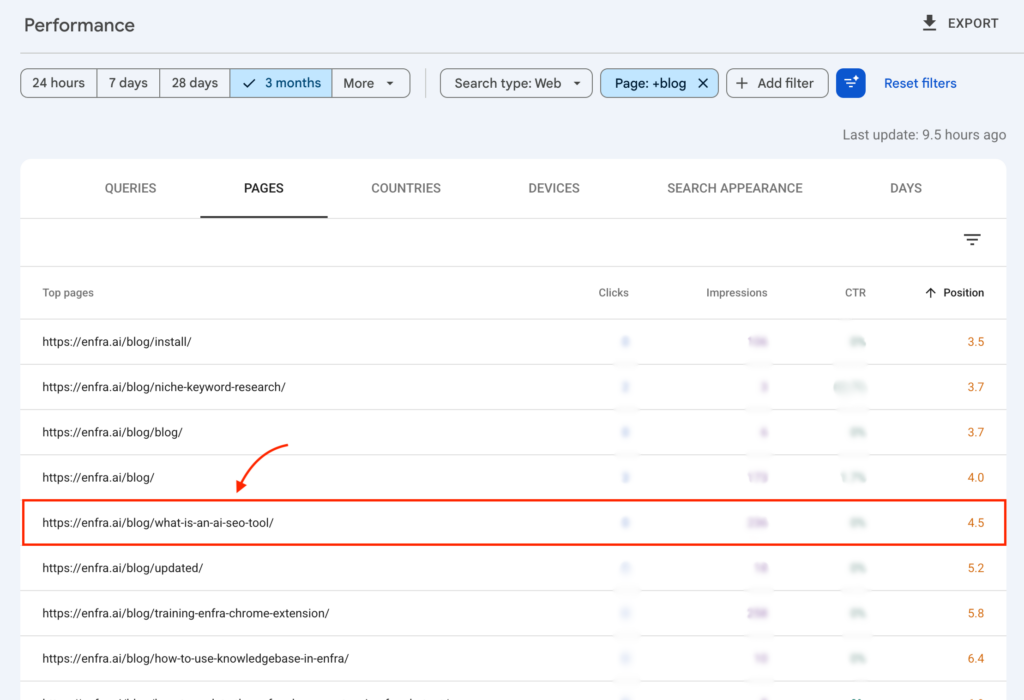
In our own inventory, “What is an AI SEO tool?” ranks at an average position of 4.5 – a textbook optimization candidate. Google already trusts the page enough to rank it near the top of page one. Improving it is a much easier problem than convincing Google to rank a brand-new article from scratch.
For a more detailed scoring framework, see our guide to running a content audit.
Step 2: Pick the right pages to optimize (the striking distance filter)
Not every page you scored in Step 1 deserves a spot in this quarter’s sprint.
- Apply the striking distance filter: pages ranking between positions 4 and 15 with meaningful impression volume (we typically start with 50+ impressions).
These pages have already demonstrated ranking potential. Industry CTR studies also show that click-through rates increase sharply as pages move closer to the top of the SERP, making this one of the highest-leverage groups of pages to optimize.
What is an AI SEO tool clears this bar easily – ranking at an average position of 4.5 with more than 50 impressions – which is exactly why it made the cut in the first place.
Ranking opportunity alone doesn’t determine priority. Business value does too.
- Next, evaluate business value. Does the page support a product, service, or another meaningful business goal?
Traditionally, this means exporting Search Console data, reviewing every candidate page, and manually deciding which ones deserve attention. Instead, connect Google Search Console to Enfra and ask:
Find all blog pages ranking in position 4-15 with 50+ impressions over the last 3 months. For each, identify the primary search intent behind the keywords driving impressions, then flag whether the page maps to a real product/service or is purely informational. Rank the results by priority – striking distance + commercial intent + confirmed business value first – and flag anything high-position but low business value as deprioritize.
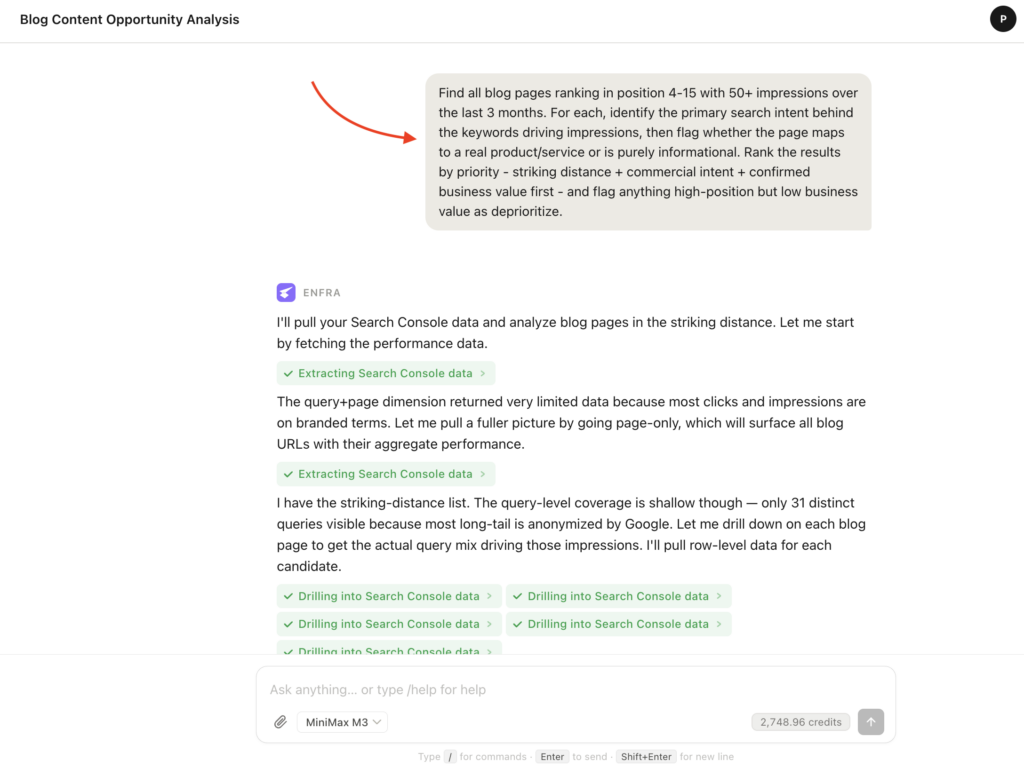
Instead of manually comparing Search Console data with your product offering every quarter, Enfra automatically builds a prioritized optimization queue. You spend your time improving pages – not deciding which ones deserve attention.
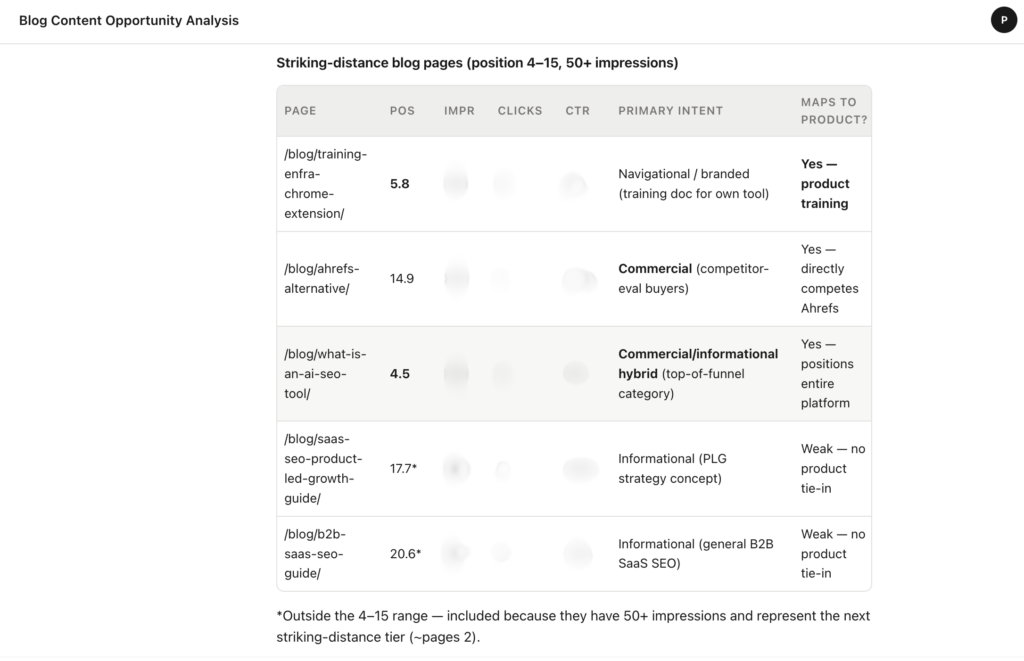
Step 3: Diagnose why each page is stuck
Step 2 identified which pages deserve attention. Now you need to understand why they haven’t reached their potential.
Resist the temptation to start making changes immediately. Two pages sitting at the same ranking position can be held back for completely different reasons. Effective content optimization starts with diagnosing the constraint before deciding on the fix.
The three most common content-related constraints are:
| Symptom | Root Cause | Fix |
|---|---|---|
| Ranks but low CTR | Intent mismatch – wrong angle vs. what actually ranks | Rewrite title/intro to match searcher intent |
| Ranks, but capped below top 5 | Thin content – competing pages answer the query more comprehensively | Expand with depth, examples, original data |
| Ranks, but volatile position | Weak internal linking and authority signals | Add contextual internal links from high-authority pages |
Traditionally, diagnosing why a page is stuck means comparing it against the SERP, reviewing the content, and auditing its internal links. Instead, let Enfra perform that diagnosis for you. Paste the following continuation prompt:
For each page flagged as high priority in the previous step, diagnose why it’s stuck. Check whether the page’s content matches the actual search intent of its top queries, compare its word count and depth against the current top 5 ranking pages for those queries, and audit how many internal links point to it from high-authority pages on the site. Return the likely root cause for each page – intent mismatch, thin content, or weak internal linking – along with the specific evidence behind that diagnosis.
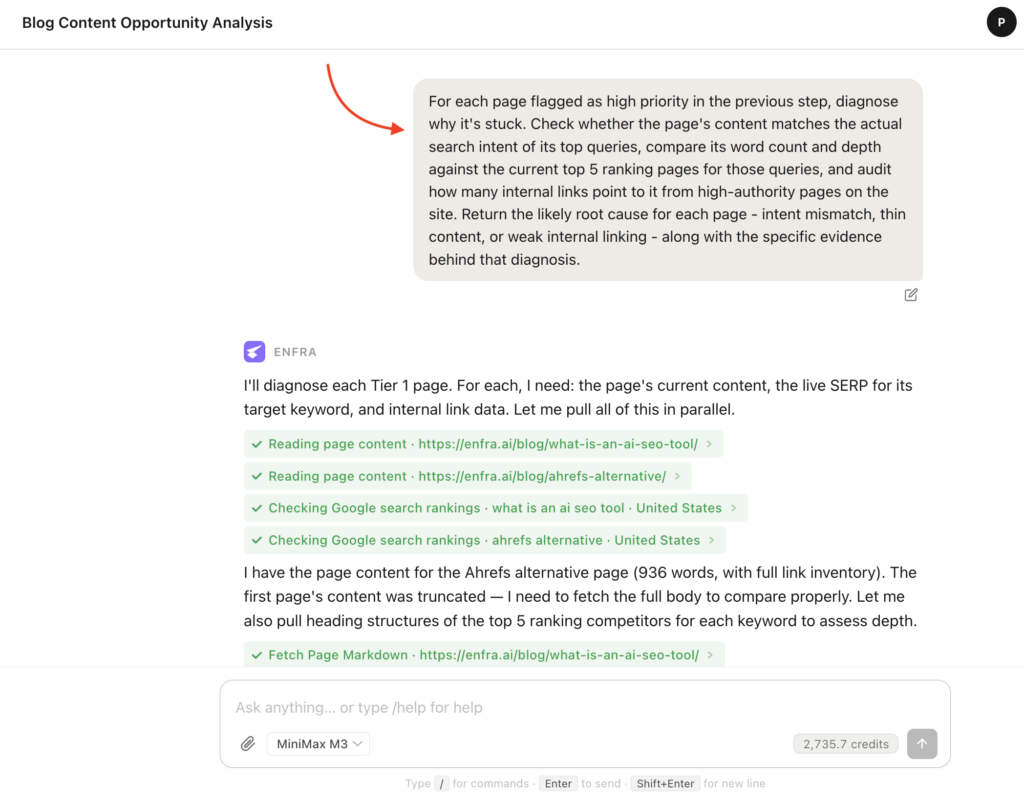
Instead of guessing why a page isn’t moving, Enfra identifies the most likely constraint and backs it with evidence from the SERP, your content, and your internal linking structure. If you’re evaluating software for that job, compare the main options in our guide to the best content optimization tools.

Step 4: Implement the highest-impact fixes
By this point, you know which pages deserve attention and why they’re underperforming. The next question is which fixes should you implement first?
Not every optimization deserves the same level of effort. Evaluate each recommendation using two dimensions:
- Expected business impact
- Implementation effort
Prioritize the changes that deliver the greatest impact for the least effort.
| Low Effort | High Effort | |
|---|---|---|
| High Impact | Do first e.g. Improve the title tag or introduction to better match search intent on a page already ranking near the top of page one. | Schedule next e.g. Rewrite a commercially valuable page that needs deeper coverage or restructuring. |
| Low Impact | Batch later e.g. Minor formatting improvements or low-priority internal linking updates. | Skip e.g. Large rewrites on pages with little ranking potential or limited business value. |
This approach keeps your team focused on the changes most likely to improve rankings and drive business results instead of treating every recommendation as equally urgent.
For more on identifying which keywords carry real commercial intent (and therefore belong in the high-impact quadrant), see our B2B SaaS SEO commercial intent guide.
Step 5: Measure, learn, and run it as a recurring motion
Optimizing a page is only half the job. The other half is measuring whether the changes actually worked.
Before making any edits, record a baseline for the metrics that matter to that page. Then compare them after the optimization has had time to settle.
Track the metrics that match your objective:
- Ranking position for visibility improvements.
- Impressions to measure changes in search visibility.
- Click-through rate (CTR) after updating titles or meta descriptions.
- Engaged sessions when improving content quality or intent alignment.
- Conversions or assisted conversions for commercially valuable pages.
The honest reason most content optimization strategies stall after the first round of edits is that nobody owns the review cadence. A 60-day review gradually turns into “whenever I have a free Friday,” which usually means never.
Instead of relying on memory, automate the recurring review.
Once it’s set up, the workflow runs on its own. Your job is no longer to remember to run another audit. It’s to review the results, identify new opportunities, and start the next optimization cycle.
Automation doesn’t replace strategy. It simply ensures your content optimization strategy gets executed consistently.
Tools that make a content optimization strategy actually executable
You don’t need a stack of ten tools to execute the content optimization strategy we’ve demonstrated above. You only need three things:
- Google Search Console – free, required. This is your source of truth for rank, impressions, and CTR.
- A content audit tool – Enfra, Surfer, or MarketMuse all work. Pick one that automates the scoring and striking-distance filtering from Steps 1 and 2, since doing this by hand in a spreadsheet doesn’t scale past a few dozen pages.
- A keyword tool – to validate search volume and intent before you commit writing time to a fix.
You can see our full breakdown in the best content optimization tools for a longer comparison.
Frequently Asked Questions
What is a content optimization strategy in SEO?
A content optimization strategy is a recurring system for improving pages you’ve already published – based on real ranking and click data – instead of a plan for what to publish next. Where a broader SEO content strategy covers everything from keyword research to publishing, content optimization is the piece focused entirely on fixing what’s already live.
What are the 5 pillars of a content optimization framework?
Inventory and scoring (rank, impressions, CTR, business value), striking-distance filtering (positions 4-15 with real impression volume), root-cause diagnosis (intent mismatch, thin content, or weak internal linking), impact-based prioritization, and a recurring review cadence. Skip any one of these and the framework breaks down into a one-time cleanup instead of a system.
How do you measure content optimization success?
Rank movement and CTR change tell you if the fix worked. Conversion lift tells you if it mattered. A page that jumps from position 12 to position 5 but doesn’t convert any better hasn’t actually moved the metric that counts – track all three, not just rank.
Is content optimization part of a broader content strategy?
Yes, but it’s the half most teams skip. Content strategy usually means “what do we publish next.” Content optimization asks “what did we already publish that’s almost working” and for most B2B content strategy teams working with limited headcount, more revenue is sitting in that second question than the first.
How often should you optimize existing content?
Every 60 days, minimum – and only if someone actually owns running it. A quarterly cadence with no owner turns into “whenever there’s a free Friday,” which in practice means never. Automate the recurring pull if you can; don’t rely on remembering.
Conclusion
Content optimization is not a one-time refresh project. It is a system for continuously finding the pages with potential, understanding what is holding them back, and improving them based on data.
The challenge has always been execution. SEO teams have access to more data than ever, but turning that data into the right actions still requires significant manual effort.
AI changes that.
Traditional SEO tools help you find opportunities. AI systems can help execute the optimization workflow – from identifying pages worth improving to diagnosing problems and prioritizing fixes.
The future of SEO won’t belong to teams that simply publish more content. It will belong to teams that build systems for continuously improving the content they already have.
Enfra helps teams turn content optimization from a manual process into an ongoing growth engine.

Intern at Enfra | Building agentic systems, web applications, and software products.