Content optimization is the process of improving existing content so it ranks better in search results, satisfies user intent, earns more clicks, and performs better in AI-generated answers.
Content optimization is one part of a broader content strategy, alongside content creation and planning. But creating more content while leaving existing pages untouched can mean sidelining assets that have already accumulated:
- Backlinks
- Search impressions
- Internal links
- Relevance within their topic clusters
Moreover, Google’s guidance emphasizes helpful, reliable, people-first content over publishing content simply for the sake of volume. Its spam policies also discourage large-scale content created primarily to manipulate search rankings.
For teams with an existing content library, that makes optimization a priority.
So, before adding another URL to your site, ask:
Could the pages we already have perform better with the right improvements?
The challenge is knowing what to optimize, what to change, and when an existing page should be improved versus when you should create something new.
That’s exactly what this guide is designed to help you figure out.
We’ll break down
- How to build optimization into your ongoing SEO workflow
- What content optimization actually means
- The six areas that matter most
- When to optimize an existing page versus create a new one
What Is Content Optimization?
At its simplest, content optimization means improving an existing page so it performs better for both users and search engines.
While optimizing your content often involves adding more, relevant information to your content, it can also involve improving:
- Search intent alignment – making sure the page answers the question or need behind the user’s query.
- Topical coverage – filling important gaps without adding unnecessary information.
- Structure and readability – making the page easier to scan and understand by both human readers and AI.
- Freshness – updating outdated information, examples, screenshots, statistics, or recommendations.
- Internal linking – connecting the page to newer relevant supporting content.
- CTR elements – improving titles and meta descriptions to better represent the page in search results.
- Conversion elements – making sure the page gives readers an appropriate next step.
And today, optimization extends beyond traditional search results.
With more people using tools like ChatGPT, Gemini, and Perplexity to answer their long-tail queries, providing clear structure, direct answers, useful context, and well-organized information becomes even more important. This also means understanding how to rank on ChatGPT is becoming part of modern content optimization.
Why Content Optimization Matters in 2026
For years, content teams have been told to publish more.
That approach made sense when the main challenge was building enough topical coverage. But once a site has hundreds of articles, publishing another page is not always the best use of time.
The bigger opportunity may already be sitting in the existing content library. SEO teams should prioritize optimizing existing pages over publishing more as:
Existing content can lose performance
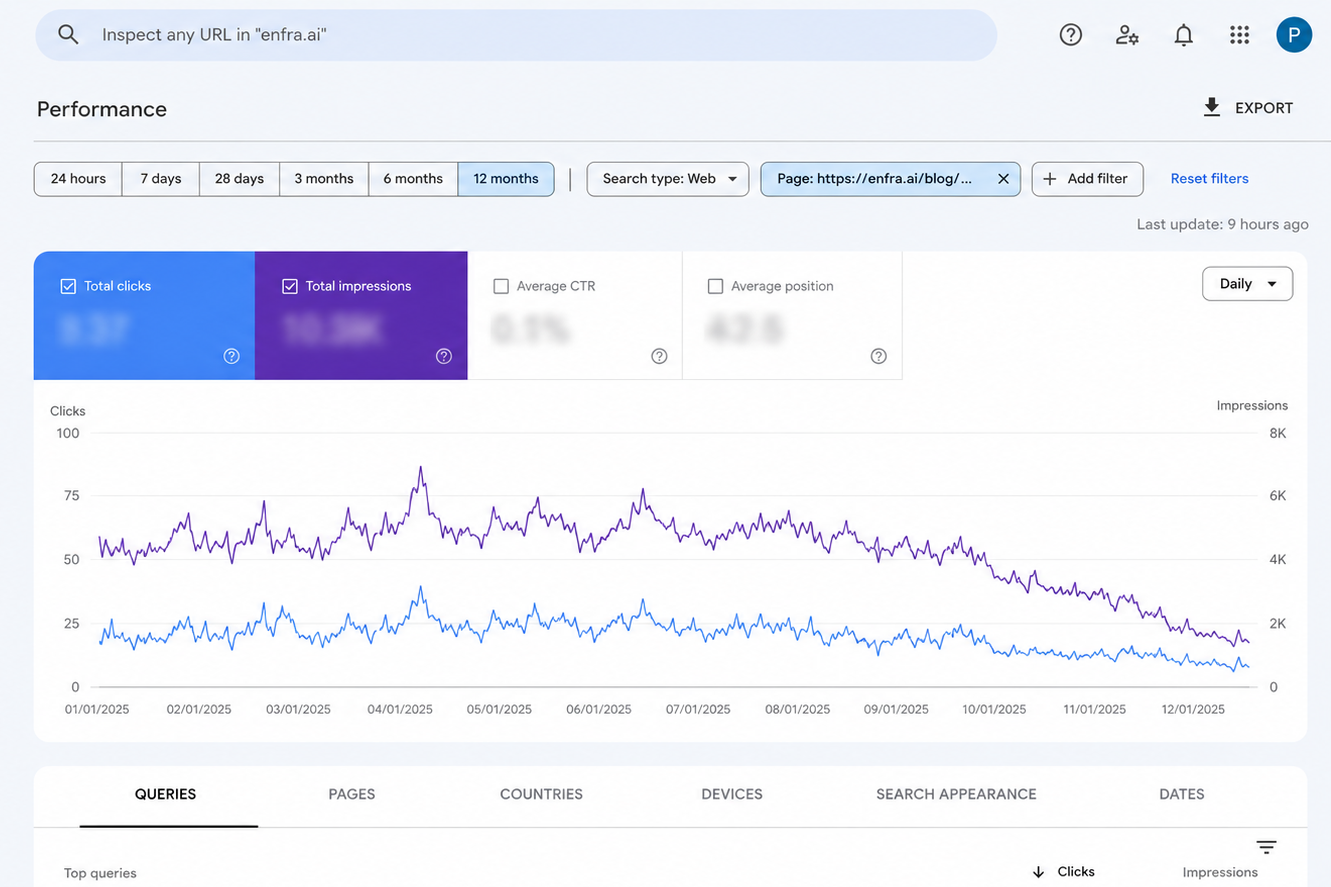
Pages that ranked well a year ago may not perform well today. This can be due to a variety of reasons including:
- Change in what the SERP looks like.
- Better resources being published by competitors.
- Shift in search intent.
- Information becoming outdated.
- New sections appearing in the results that your page does not address.
Without regular optimization, content can gradually lose visibility without anyone noticing until the decline becomes significant.
Search intent changes over time
What users expect when they type a query changes with time.
A query that once produced mostly informational articles might later show comparison pages, templates, product pages, or other formats.
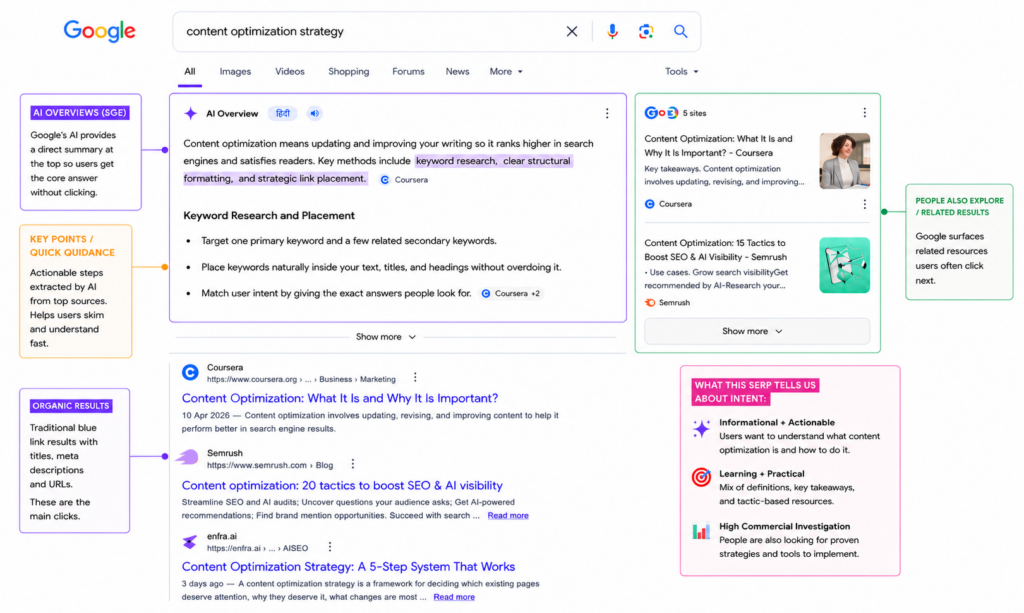
Pages that worked in 2022 still work – but only for the intent they were written for. When intent shifts, the page becomes a candidate for optimization, not a candidate for deletion.
Existing pages already have something to build on
As already established, an existing page may have:
- existing conversions
- rankings and impressions
- backlinks
- historical authority
- internal links
- indexed content
- user engagement
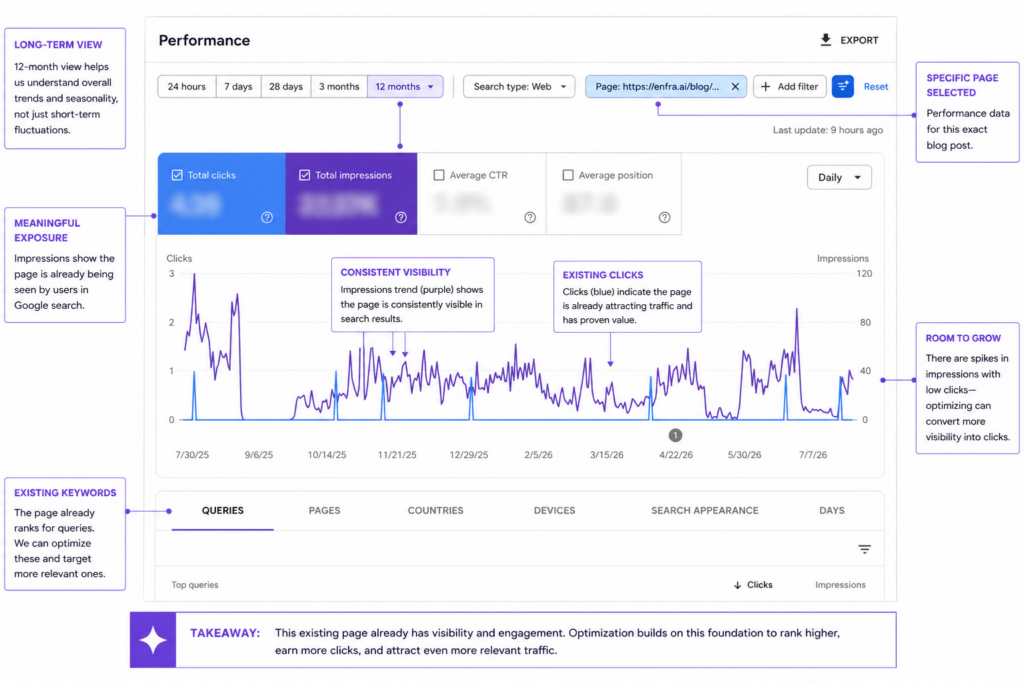
That means optimization can sometimes be a much more efficient path than starting from zero.
AI is changing how content is discovered
Search is increasingly moving beyond a simple list of blue links.
AI-generated search experiences and answer engines can surface information from pages based on how clearly and comprehensively those pages address a topic. And that makes content quality, organization, context, and answerability even more important.

The 6 Core Pillars of Content Optimization
1. Search Intent Alignment
The first question to ask is simple:
Does this page actually satisfy what the searcher wants?
A page can be well written and still perform poorly if it answers the wrong question.
For example, someone searching for “content optimization tools” is probably looking for software options. A page explaining the theory of content optimization may be useful, but it does not fully satisfy that intent.
Before changing a page, look at the current SERP and understand what it is rewarding. Is the intent:
- informational?
- commercial?
- transactional?
- navigational?
Then compare that intent with the actual page.
But intent is only part of the picture. Look at the format of the results Google is rewarding, too.
Are the top results mostly:
- listicles or comparison pages?
- how-to guides or blog posts?
- free tools or calculators?
- SaaS product or feature pages?
- ecommerce product or category pages?
- templates, checklists, or other resources?
If most of the results follow a particular format, that is a signal about what searchers currently expect from the query.
For example, if a keyword is dominated by free tools, rewriting your existing blog post to add more information may not be enough. The page itself may need to be repositioned or reformatted to better match the SERP.
In other words, content optimization is not always about improving the words on the page. Sometimes, the page format itself needs to change.

If the mismatch is fundamental, adding more content may not help. The page may need to be repositioned, consolidated, or replaced with a more appropriate resource.
2. Topical Coverage and Comprehensiveness
Once intent is right, the next question is whether the page covers the topic well enough.
This does not mean making every article longer.
A comprehensive page is one that covers the information a reader reasonably needs to accomplish what they came for.
That might mean adding:
- an important subtopic
- a missing use case
- a relevant example
- a comparison
- an explanation of a key concept
- answers to common follow-up questions
The goal is not to maximize word count.
It is to close meaningful gaps.
A 2,000-word article that answers the user’s questions clearly is more useful than a 4,000-word article padded with information that does not help them.
3. Structure and Readability
Even useful information can underperform if it is difficult to consume. Content optimization should make the page easier to scan and understand. That can involve:
- clearer heading hierarchy
- shorter paragraphs
- stronger introductions
- descriptive subheadings
- bullet points where appropriate
- tables or visuals when they genuinely simplify a concept
- direct answers to common questions
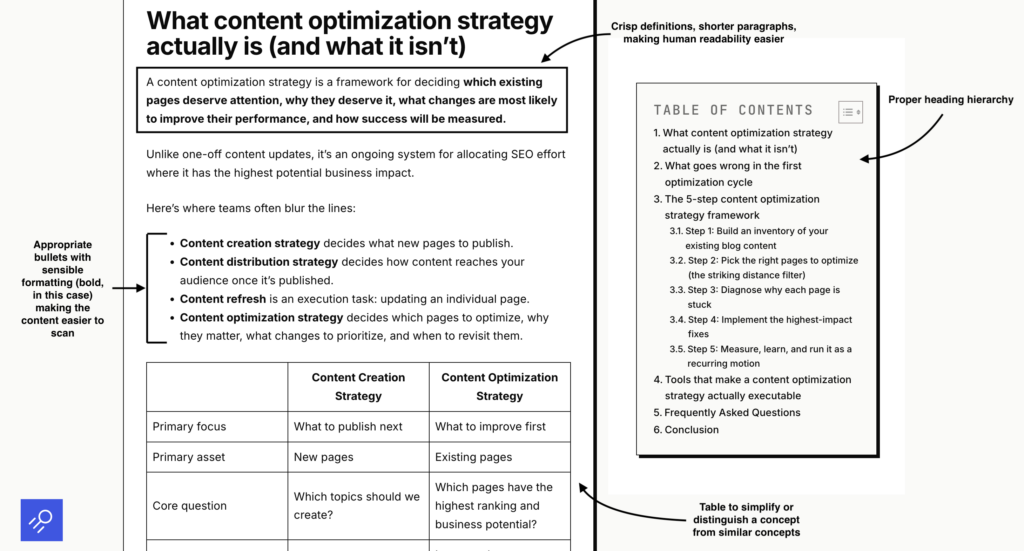
Good structure matters for readers because they rarely read every page from beginning to end.
It also matters in modern search experiences, where clear sections and directly expressed answers make information easier to scan and cite in LLM answers.
4. Freshness and Content Refreshes
Some content becomes less useful simply because it gets old.
Examples, screenshots, statistics, product information, recommendations, and best practices can all change.
A content refresh might involve:
- replacing outdated examples
- updating screenshots
- checking statistics and sources
- removing obsolete recommendations
- updating dates and references
- rewriting sections that no longer reflect current practices
But freshness is only one part of content optimization.
A page can be current and still have weak intent alignment, poor structure, missing information, or weak conversion paths.
That is why refreshing content should be treated as one optimization play rather than the entire optimization process.
5. Internal Linking and Context
A page does not exist on its own.
Internal links help users discover related information and help search engines understand how different pages on a site relate to one another.
For example, a page about content optimization might link to:
- a deeper strategy guide
- a content audit guide
- a guide to content refreshes
- relevant product or use-case pages

The goal is not to add as many links as possible. It is to create useful connections.
A reader should be able to move naturally from a broad topic to a more specific one, while your site’s content structure becomes clearer at the same time.
6. Conversion Alignment
Ranking is not the only reason to optimize a page.
A page can generate significant organic traffic and still have little business impact if visitors have no clear next step. Conversion alignment means making the action on the page appropriate for the reader’s intent and stage.
For example, an informational article may be better served by a relevant educational resource or a light product CTA, while a high-intent commercial page may be ready for a demo or free trial.
The objective is to make the journey from search → answer → next action feel natural.
Content Optimization vs. Related SEO Concepts
Content optimization overlaps with several other areas of SEO. Understanding the difference helps you decide what problem you are actually trying to solve.
Content Optimization vs. Content Strategy
Content strategy is the broader system. Content optimization is the execution layer.
A content strategy determines what topics to cover, which audiences to target, what content to prioritize, and how content supports business goals.
Content optimization focuses on improving individual pages within that system.
For the deeper understanding of our internal content optimization strategy, see our content optimization strategy guide.
Content Optimization vs. Content Audit
A content audit diagnoses the content library. It helps you understand what you have, how it is performing, where problems exist, and what action each page may require.
Content optimization improves the pages selected for action. In other words:
Audit → diagnose
Optimization → improve
You can learn more about running a diagnosis for your content in our content audit guide.
Content Optimization vs. Content Refresh
A content refresh usually focuses on updating an older page. That might include refreshing statistics, examples, screenshots, or outdated recommendations.
Content optimization is broader.
A page can need optimization even if its information is current. It may have an intent mismatch, weak structure, poor internal linking, low CTR, or a weak conversion path.
Content Optimization vs. On-Page SEO
On-page SEO is one part of content optimization. It can involve elements such as headings, title tags, meta descriptions, internal links, and other page-level signals.
Content optimization goes beyond these technical elements to consider whether the actual content is useful, complete, relevant, current, and aligned with what the searcher needs.
Content Optimization vs. Topical Authority
Topical authority is an outcome. Content optimization is one way to build it.
A site develops stronger topical coverage by consistently creating and improving useful content around a subject. Optimizing existing pages helps strengthen that coverage by filling gaps, improving relationships between pages, and making individual resources more useful.
Should You Optimize an Existing Page or Create a New One?
One of the most important content decisions is also one of the easiest to get wrong.
When a topic is underperforming, the answer is not always “publish another article.” Sometimes the best move is to improve the page you already have.
Optimize an existing page when:
The page already has some traction. Here you can look for signals such as:
- existing impressions
- page-two or low-page-one rankings
- relevant keywords
- backlinks or historical authority
- existing traffic
Optimization is also a strong option when the page is fundamentally relevant but needs improvement. For example, the intent is still correct, but the article is outdated, incomplete, poorly structured, or missing important subtopics.
Create a new page when:
A new page is usually more appropriate when the topic or intent is genuinely different. That includes situations where:
- the keyword has a different intent
- the existing page is too broad
- the new topic deserves standalone depth
- combining the topics would make the content harder to understand
- the existing page cannot realistically satisfy both searches
A useful rule is: Optimize when the page is relevant but underperforming. Create a new page when the topic or intent is fundamentally different.
The Most Common Content Optimization Strategies
Not every page needs the same type of intervention. Here are some of the most common ways teams improve existing content:
Refresh decaying content
A page that used to perform well but has steadily lost visibility may need a refresh. Review what changed in the SERP, update outdated information, and close any gaps that have emerged.
Expand thin pages that already rank
Some pages have the right topic and intent but do not cover the subject deeply enough. Instead of replacing them, improve the sections that are missing or underdeveloped.
Improve high-impression, low-CTR pages
A page can appear in search frequently without generating many clicks. In these cases, the content may already have ranking potential. The title and meta description may simply need to communicate the value of the page more clearly.
Merge overlapping articles
Multiple articles covering very similar topics can compete with one another. When two pages have overlapping intent and neither is performing well independently, consolidation may create a stronger resource than keeping both.
Add missing FAQs and subtopics
Sometimes the main article is strong but misses the questions that naturally follow the primary topic. Adding genuinely useful answers can make the resource more complete without rewriting the entire page.
Strengthen internal links
Content that attracts visitors but does not connect them to relevant next steps can become an isolated asset. Adding contextual internal links can help readers discover related resources and move toward more relevant pages.
Optimize for AI Overviews and answer engines
Modern content also needs to be easy to understand and extract. That means:
- answering important questions directly
- using clear headings
- structuring information logically
- avoiding unnecessary ambiguity
- providing enough context to make individual sections meaningful
The objective is still to create genuinely useful content. The difference is that the is now more optimized for search and answer experiences.
How to Measure Content Optimization Success
Measuring content optimization success isn’t just about rankings – it’s about understanding whether your updates are actually improving performance and user engagement.
To evaluate impact properly, you need to look at a combination of SEO, traffic, and on-page behavior signals.
| Metric | What It Measures | Why It Matters | How to Track It |
|---|---|---|---|
| Organic traffic | Number of users coming from search engines | Shows whether optimized content is gaining visibility | Google Search Console, GA4 |
| Keyword rankings | Position of target keywords in SERPs | Indicates SEO performance improvements over time | Enfra, GSC |
| Click-through rate (CTR) | Percentage of users who click your result in search | Reflects how compelling your title and meta description are | Google Search Console |
| Engagement rate | Time on page, scroll depth, and interactions | Shows whether the content is actually useful to readers | GA4, Hotjar |
| Conversions | Leads, sign-ups, or purchases from the page | Measures the business impact of the content | GA4, CRM tools |
| Backlinks earned | Number of external sites linking to the page | Signals authority and content value | Enfra |
Frequently Asked Questions About Content Optimization
What is content optimization in SEO?
Content optimization is the process of improving existing content so it better matches search intent, covers the topic effectively, performs better in search, and supports business goals.
How is content optimization different from content strategy?
Content strategy is the broader system for deciding what content to create, who it is for, and how it supports business goals. Content optimization focuses on improving individual pages within that system.
How often should you optimize content?
There is no universal schedule for every page. High-priority pages should be reviewed when rankings, traffic, search intent, or the underlying information changes. Some pages may need frequent attention, while stable evergreen pages may require much less.
Is content optimization the same as on-page SEO?
No. On-page SEO is one component of content optimization. Content optimization also considers factors such as topical coverage, freshness, readability, search intent, internal linking, and conversion performance.
Should you optimize old content or publish new content?
It depends on the page and the search intent. Optimize an existing page when it is relevant and has useful existing signals such as impressions, rankings, or backlinks. Create a new page when the topic or intent is meaningfully different.
Can AI help with content optimization?
Yes. AI can help with tasks such as analyzing SERPs, identifying content gaps, suggesting improvements, updating sections, and automating repetitive workflows. The quality of the result still depends on the context, inputs, and human judgment behind the process.
What is a content optimization tool?
A content optimization tool helps teams improve existing pages by supporting tasks such as SERP analysis, content gap detection, prioritization, internal linking, recommendations, and workflow automation.
Conclusion
Content optimization is not about making every article longer or endlessly tweaking pages for rankings. It is about making better use of the content you already have.
That means understanding what searchers want, identifying where a page falls short, fixing the right problems, and measuring whether those changes actually improve performance.
The strongest optimization programs tend to follow the same principle:
Do not optimize everything. Optimize the pages where improvement can create the most impact.
Start with intent. Look at the current SERP. Find the gap. Improve the page. Then measure what changed. And as your content library grows, make that process systematic rather than occasional.
For the deeper frameworks behind that process, you may explore our guides on content optimization strategy, content audits, and content optimization tools.

Marketing Engineer at Enfra | Building agentic systems, web applications, and software products.