Good content doesn’t always rank on the first page of Google.
Content optimization bridges the gap between writing good content and improving visibility on Google and AI engines.
Most content optimization tools were originally built for the blue-links era. As AI search has evolved, newer AI-native platforms like Enfra have started approaching optimization differently. This guide focuses on the tools themselves, while our content optimization strategy guide explains how teams build a repeatable process around them.
We tested the leading content optimization tools and ranked the best options for SEO teams in 2026, covering real pros, cons, pricing, and the ideal user for each.
What are Content Optimization tools?
A content optimization tool analyzes top-ranking pages for a keyword and tells you what to add, edit, or remove so your content has a better chance of ranking.
Traditional content optimization tools follow a fairly standard workflow:
- Pull a live Google SERP for your target keyword.
- Analyze the top-ranking pages.
- Extract the topics, entities, and NLP terms they cover.
- Compare your draft against that baseline.
The output usually includes:
- A content or optimization score.
- Missing terms and entities.
- Readability recommendations.
- Sometimes a content brief or outline.
That workflow is still effective for improving traditional search rankings. However, it’s no longer enough on its own.
The latest generation of tools also optimizes for AI search (GEO), treating ChatGPT, Claude, Gemini, Perplexity, and AI Overviews as search surfaces worth optimizing for.
That means they go beyond keyword coverage to:
- Understand search intent before generating a brief.
- Verify the finished content matches that intent.
- Check whether the article is comprehensive enough to earn AI citations.
- Optimize for both Google rankings and AI visibility.
Prompting ChatGPT isn’t the same as prompting Gemini, and the same holds true for other AI engines. Each has different citation and retrieval patterns, so optimization strategies need to adapt accordingly. You can read the detailed comparison of how different AI engines cite content and what to optimize for in each.
In 2026, content optimization is no longer just about keyword density. The best tools research, write, verify, and optimize for both Google and AI search.
How We Tested (Our Methodology)
We tested several tools against the following seven criteria and ranked them to suit the 2026 content optimization scenario.
- Research depth – Accuracy in performing live SERP analysis, top-10 page reads, AI overview tracking, and AEO fan-out across ChatGPT, Claude, and Perplexity.
- AI-native intent alignment & comprehensiveness – Does the tool check search intent before the brief, verify the draft matches that intent after, and confirm the piece is more comprehensive than what’s currently ranking?
- Format flexibility – Can you optimize in your team’s own format, or does the tool force its template on you?
- Output quality – Depth and actionability of briefs and recommendations.
- Workflow automation – Triggering scheduled and bulk operations and reducing the manual load. Whether the workflow automates the work of 3 or more SEOs or not.
- Project integrations – Seamlessly integrating the workflow with product CMS like Google Search Console, Google Business Profile, Slack, Zoho, etc.
- Price-to-value – Is the product serving the value it promises? Does the pricing justify the product capabilities?
Best Content Optimization Tools at a Glance (Comparison Table)
| Tool | Best for | Standout feature | Starting price | Website |
| 1. Enfra | Teams wanting the work done, not just reported | Checks intent before & after writing, follows your uploaded format, full SERP + AI-surface research | $199/mo | Visit Enfra |
| 2. Surfer SEO | On-page content scoring | NLP term coverage editor | Monthly plans starting at $119/mo and annual plans at $99/mo | Visit Surfer |
| 3. Clearscope | Enterprise editorial teams | Clean report + readability | Essentials Plan at $129/mo. Pricing scales with advanced features and content. | Visit Clearscope |
| 4. Frase | Fast brief creation | AI outline + SERP summaries | Starts at $49/mo for monthly plans and $39/mo for annual plans | Visit Frase |
| 5. MarketMuse | Topic modeling / authority | Content inventory scoring | Starts around $149/mo for the Standard plan | Visit MarketMuse |
| 6. Scalenut | AI writing + optimization | Cruise mode drafting | Monthly plans starting at $59/mo; Annual plans currently starting at $24/mo (60% offer for a limited time) | Visit Scalenut |
| 7. NeuronWriter | Budget SERP-based editing | Affordable term targeting | Starting bronze plan at $23/mo for monthly plans and $19/mo for annual plans | Visit NeuronWriter |
The Best Content Optimization Tools Reviewed
Here’s a more comprehensive analysis of the top 7 best content optimization tools:
1. Enfra – Best Overall for SEO Teams and Agencies

Enfra is the only tool in this list that’s genuinely AI-native.
It stands out from everything else because of its
1) intent-aware loop – Before Enfra builds a brief, it checks what Google is rewarding on the SERP, what kind of page is winning, and what angle is missing. Once the draft is written, Enfra verifies whether the draft actually follows that intent and confirms the piece is more comprehensive than what currently ranks.
2) bring your own format – Most tools want your content to align with their specified standards, which means every doc has to be edited manually to suit your internal format. However, Enfra lets you upload your format to the knowledge base once, and every optimization doc it produces follows your structure automatically.


Pros
- Chat-native interface – nothing to learn, just ask in plain English.
- Read full SERP + AI Overviews + ChatGPT/Claude/Perplexity fan-out before writing.
- Brand knowledge base integration – incorporates your positioning, products, and CTAs into every brief.
- Strong internal linking analysis and keyword gap detection across your existing content.
- Scheduled workflows to Slack, email, and Google Drive.
- Full WordPress integration for direct publishing.
- GSC, GA4, and live SERP data on every job.
Cons
- No free tier, only a free trial.
- Pricing is at the top of the category ($199/month)
Best for
SEO teams and agencies that want to ship more without scaling headcount.
Pricing
$199/mo – You get full research stack on every brief, creation, and update. If your main need is keeping aging content competitive, pair the tool with a structured content refresh checklist.

2. Surfer SEO – Best for Solo On-Page Scoring

Surfer is the standard editor that covers NLP and has defined the category for most SEOs. It scores your draft against what the top-ranking pages cover, line by line, with a live content score as you write.
Pros
- Real-time NLP term-coverage editor
- Deep SERP comparison via the SERP Analyzer
- Largest user community in the category
- AI-search visibility is prominent
Cons
- Forces the Surfer editor format on every draft
- AI visibility is a separate module, and not woven into the workflow
- Provides no details on whether the piece matches intent
- Limited scheduled workflows
- Pricing is one of the highest in the category
Best for
Solo writers and in-house teams that want detailed on-page NLP scoring, a large community for support, and AI citation tracking as an add-on.
Pricing
Monthly plans starting at $119/mo and annual plans at $99/mo; Pro and Peace of Mind plans add more content and AI features

3. Clearscope – Best for Enterprise Editorial Teams Needing Clean Shareable Reports

Clearscope is a premium enterprise-grade content optimization platform which generates clean, shareable reports and allows team collaboration for editorial teams producing content at volume.
Pros
- High-quality, shareable optimization reports
- Readability + term-coverage scoring
- Google Docs and WordPress integrations
- Enterprise-grade SSO and permissions for larger teams
Cons
- Fixed report format
- No user-intent classification before or after writing
- No AI-search optimization
- Limited comprehensiveness benchmarking
- One of the highest pricing in the category
Best for
Enterprise editorial teams that value clean, shareable reports, team workflows, and readability scoring and don’t need AI-surface or intent verification.
Pricing
Essentials Plan starting at $129/mo, business and enterprise plans come with advanced pricing, scale as well as features.

4. Frase – Best for Fast Brief Creation on a Budget

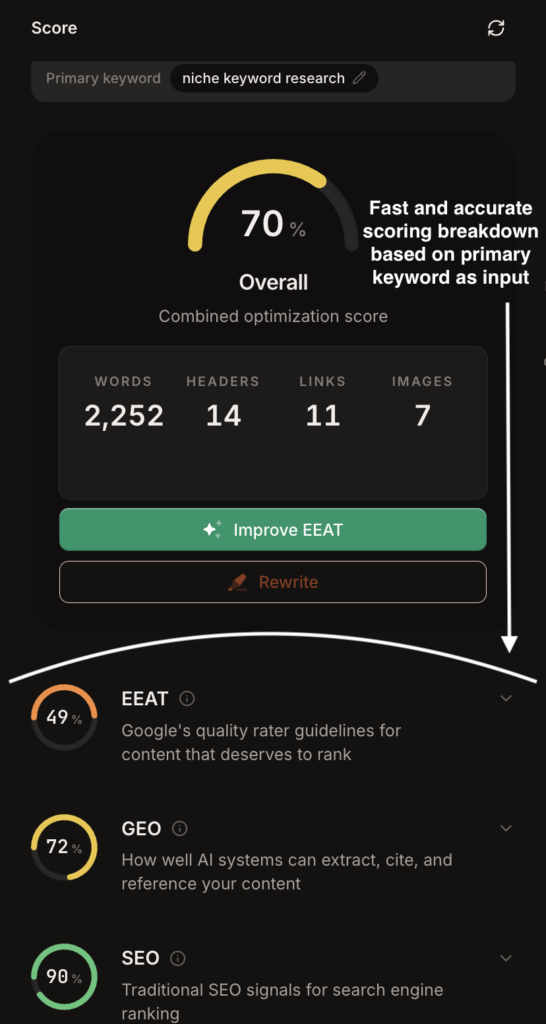
Frase is a budget-friendly content research and optimization tool that’s built for speed. It provides AI assistance and SERP check in a single streamlined platform. Content metrics breakdown is based on E-E-A-T, SEO, and GEO.

Pros
- Fast SERP-based brief generation
- AI-powered outline builder
- Question-extraction feature that surfaces the PAA questions for any keyword
- Affordable entry price
- Content scoring editor that grades your draft against competitors
Cons

- Forces Frase’s outline format
- No user-intent detection
- Less depth in the AI-surface checks
- Limited comprehensiveness benchmarking
- No native scheduled workflows
Best for
Solo writers, freelancers and small teams who need a fast, cheap SERP-based brief and don’t need AI-native or enterprise features.
Pricing
Starts at $49/mo for monthly plans and $39/mo for annual plans; Pricing increases for advanced features and shipping content at scale.

5. MarketMuse – Best for Portfolio-Level Topic Modeling and Authority Strategy

MarketMuse is a content strategy platform built around topic modeling across your entire content inventory. It is useful for teams planning authority in a topic cluster, not just optimizing one article at a time. It provides features like content scoring, topic modeling, and competing content analysis.
Pros
- Easy to use and provides actionable insights for content optimization
- Strong topical authority scoring
- Personalized Difficulty score for each topic of your page
- Heatmap view of competitor SERPs
- Preferred for content strategy, not just one-off articles
Cons
- Expensive as compared to other tools
- AI assistance is in-built but not optimal for generation
- The editor can slow down with heavy usage
Best for
Large content sites planning long-term topical authority.
Pricing
Starts around $149/mo for the Standard plan while higher tiers unlock the full inventory and competitive analysis features.

6. Scalenut – Best Budget AI Drafting + On-Page Optimization in One Tool

Scalenut offers content optimization as one of its features among other features like content planning, keyword research, tracking AI visibility, buying backlinks, etc.
It is designed with a special focus on Generative Engine Optimization (GEO) and helps create content optimal for both search engines as well as generative engines.

Pros

- Easy to use for first time users
- Combines keyword research, brief, AI writing, and on-page optimization in a single workflow
- Cruise mode generates first drafts quickly
- Strong GEO framework
- Lower price point than Surfer, Clearscope and MarketMuse
Cons

- No user-intent classification before or after writing
- No consideration of brand voice
- AI-generated drafts require heavy human editing before publish
- Many times the AI suggestions are irrelevant
- Steep learning curve because of too many features
Best for
Budget-conscious solo writers and small teams producing high-volume content where the alternative is no content. A human editor has to be willing to rewrite the AI output.
Pricing
Monthly plans starting at $59/mo while annual ones are currently starting at $24/mo (60% off for a limited time); higher tiers add AI credits and team features.

7. NeuronWriter – Cheapest SERP-Based NLP Editing for Solo Writers

NeuronWriter is a budget-friendly SERP-based NLP editor that brings Surfer-style term coverage to solo writers at a fraction of the price.

Pros

- SERP-based NLP editor
- Easy to navigate interface
- One of the lowest price points in the category
- AI writing assistant built into the editor
Cons

- Forces the NeuronWriter editor format
- No user-intent detection before or after writing
- AI-generated content often requires heavy human editing
- Smaller integrations footprint than Surfer, Frase or Enfra
- No native scheduled workflows
Best for
Freelancers and very small teams that want cheap, SERP-based NLP editing and don’t need AI-native verification or enterprise features.
Pricing
Bronze plan starting at $23/mo for monthly plans and $19/mo for annual plans with advanced features and credits for premium tiers.

How to Choose the Right Content Optimization Tool
Choosing the right content optimization software is less about comparing prices among tools and more about comparing every tool’s price to the value it serves.
Here are the factors worth evaluating before choosing a tool:
- Prioritize search intent over keyword coverage
Older tools mainly score your content against the terms used by top-ranking pages. While that’s still useful, it doesn’t tell you whether the article actually satisfies the intent behind the search.
Look for tools that can identify search intent before creating a brief and verify that the final draft still aligns with it after writing.
A good place to learn about the search intent behind a keyword is Enfra. Simply start with the prompt:
“Analyze the search intent for the keyword ‘[keyword]’ and explain what type of content is most likely to rank, why users search for it, and what topics the page should cover.” - Consider AI-search optimization
Google is no longer the only place people discover content. ChatGPT, Gemini, Claude, and Perplexity all surface content differently.
If AI visibility matters to your business, choose a tool that goes beyond Google SERP analysis and helps optimize for AI citations as well.
Tools like Enfra and Scalenut were built to optimize for both AI and search engine visibility whereas AI content optimization tools like Frase and SurferSEO are also good for surface level checks. - Evaluate how much work the tool actually automates
Some tools stop at generating recommendations. Others automate research, briefing, optimization, and content refresh workflows. If your team publishes content regularly, automation often saves more time than another optimization score. - Make sure the workflow fits your team
The right tool depends less on the feature list than on who’s using it and how much you publish.
For solo SEOs and bloggers, affordable content optimization platforms like NeuronWriter and Scalenut provide real scoring without costing too much.
For in-house marketing teams and agencies who need consistency across brief formats, Enfra is the only platform that offers a knowledge base and MarketMuse is the go-to platform that provides strong content strategies. - Compare value more price
Buying a $23 or $49 tool with a focus on cost-cutting usually means you’re going to have to consider add-ons in future, navigate from one tool to another, and sit through hours of manual editing.
Pricier content optimization tools ranging from $119 and above are packed with AI features optimal for the 2026 landscape.
Frequently Asked Questions
What is a content optimization tool?
A content optimization tool analyzes your content against top-ranking pages for a target keyword and recommends ways to improve it. Traditional tools focus on keyword coverage, readability, and topical relevance, while newer AI-native platforms also evaluate search intent, comprehensiveness, and AI search visibility across platforms like ChatGPT, Gemini, Claude, and Perplexity.
Which is the best content optimization tool?
The best content optimization tool depends on your workflow and publishing goals. If you need AI-native research, search intent verification, and workflow automation, Enfra is the strongest choice. Surfer SEO remains a solid option for on-page optimization, Clearscope is well suited for enterprise editorial teams, while Frase and NeuronWriter offer affordable alternatives for smaller teams and freelancers.
Can ChatGPT replace content optimization tools?
No. ChatGPT can help brainstorm, write, and edit content, but it doesn’t automatically analyze live SERPs, identify content gaps, verify search intent, or benchmark your content against competing pages. Content optimization tools combine these capabilities to help improve your chances of ranking in both search engines and AI search.
What features should I look for in a content optimization tool?
Look for features such as accurate SERP analysis, search intent detection, content gap analysis, AI search optimization, workflow automation, and flexible formatting. The best tools should improve your existing workflow rather than forcing you to work inside a rigid editor.
Do content optimization tools guarantee rankings?
No. Even the best content optimization tools cannot guarantee rankings. Search performance depends on several factors, including backlinks, domain authority, technical SEO, competition, and how well your content satisfies user intent. These tools improve your content’s quality and relevance, but they are only one part of a successful SEO strategy.
Final Verdict
The best content optimization tool depends on your workflow, team size, and publishing goals. While traditional platforms still excel at keyword optimization and on-page scoring, AI-native tools are changing how SEO teams research, optimize, and refresh content for both Google and AI search.
If you’re looking to automate more of your workflow – from search intent analysis and content briefs to AI optimization and content refreshes – it’s worth trying an AI-native approach.
Ready to see it in action?
- Start using Enfra to experience AI-native content optimization firsthand.
- Book a demo if you’d like a personalized walkthrough of how Enfra fits your team’s workflow.

Intern at Enfra | Building agentic systems, web applications, and software products.