
A lot of teams use “content brief” and “content outline” as if they mean the same thing. They’re connected, but they serve different purposes.
A content brief defines the assignment: who the content is for, why it should exist, what it needs to accomplish, and what the writer needs to know before drafting.
A content outline defines the structure: which sections the piece should contain, what each section should cover, and how the ideas should flow from beginning to end.
The distinction matters because a well-structured article can still be the wrong article. A brief provides the strategic direction; the outline turns that direction into a draftable structure.
Turn Strategy Into Structure →Content Brief vs Content Outline: The Short Answer
| Content brief | Content outline | |
|---|---|---|
| Purpose | Defines the assignment | Defines the structure |
| Main question | What should we create and why? | How should the piece be organized? |
| Focus | Strategy and direction | Flow and coverage |
| Typical contents | Keyword, intent, audience, angle, goals, SERP insights | H1, H2s, H3s, section notes, examples |
| Created | Before outlining | After the brief |
| Primary users | Strategist, editor, writer | Writer, editor |
The simplest way to remember it:
The brief defines the job. The outline maps the page.
Both a content brief and a content outline exist to make a draft easier to write and easier to update later. The brief reduces strategic confusion; the outline reduces structural confusion. Together, they help teams produce cleaner first drafts and reduce the work involved when a post needs a content refresh months later.
What Is a Content Brief?
A content brief is the document that tells a writer what success looks like before they start drafting.
It usually defines the target keyword, search intent, audience, content goal, unique angle, and other requirements that could affect the final piece. For SEO content, it may also include SERP research, competitor gaps, internal links, examples, and the desired CTA.

Ask Enfra to generate the brief for your next blog post, SEO article, or landing page and it will define everything from keyword and intent to internal links and brand notes.

The point of a brief is not to give the writer as many notes as possible. It is to remove avoidable ambiguity. If a writer has to guess who the article is for, what the reader wants, or what the article should accomplish, the draft can go in the wrong direction before the first paragraph is finished.
For a practical example, see our content brief template, which shows how we structure a brief around audience, intent, goals, and reader value.
A strong brief typically covers:
- Target keyword: The primary search term the content is targeting.
- Search intent: What the searcher is actually trying to find or accomplish.
- Target audience: The specific reader the content is written for.
- Content goal: What the article should help the reader understand or do.
- Unique angle: How the article will provide something more useful or specific than existing results.
- SERP or competitor insights: What competing pages already cover and where there are opportunities to improve.
- Internal links: Relevant pages that should be linked from the article.
- CTA: The action the reader should take after consuming the content.
- Tone and brand notes: Any style, terminology, or brand requirements the writer should follow.
What Is a Content Outline?

Enfra’s Content Brief Skill defines separate instructions for the content outline as it’s the part the writer actually works from.
A content outline is the structure for the draft itself.
It breaks the article into sections, usually using an H1, H2s, and H3s, and explains what each section needs to cover. The writer can create the outline from the brief, or an editor or strategist can provide it as part of the assignment.
An outline answers a different question from the brief: What does the reader encounter, and in what order?
A useful outline might include:
- Working title
- Introduction direction
- H2 and H3 structure
- Section-level notes
- Examples or proof points
- FAQ questions, when relevant
- Closing direction
The important thing is that an outline should do more than list headings. Structure is one of the first things you check when improving an existing piece, because weak section flow usually shows up fast during content optimization.
Compare:
H2: What Is Content Decay?
with:
H2: What Is Content Decay?
Explain how a page can lose organic visibility even when the topic still has demand. Distinguish ranking decline from normal seasonal traffic fluctuations and introduce the signals used to identify genuine decay.
The second version gives the writer something to work with. It establishes what the section needs to accomplish without writing the section for them.
A useful outline should make the path through the article obvious. The writer should be able to move from the introduction to the final section without having to figure out the article’s structure from scratch.
The Key Difference Between a Content Brief and Content Outline
The core distinction is simple:
A content brief is strategic. A content outline is structural.
The brief explains:
- who the content is for
- what the reader needs
- why the piece should exist
- what it should accomplish
- what makes the angle useful or different
The outline explains:
- which sections the article needs
- what order they should appear in
- what each section should cover
- how the ideas should connect
If you only give a writer an outline, they may know the section order but still miss the audience, intent, or business goal.
If you only give them a brief, they may understand the assignment but still have to figure out the article’s structure themselves.
That’s why the two work well together.
Brief → direction → outline → structure → draft
The brief comes first because the structure should follow the strategy, not the other way around.
What Goes Into a Content Brief?
The exact format will vary by team, but these are the elements that usually provide the most value.
1. Target keyword
Name the primary keyword the article is targeting. Secondary keywords and related questions can be included when they help define the topic.
For more on sharpening keyword research and mapping keywords to the right intent and audience, read our guide on niche keyword research.
2. Search intent
Explain what the searcher wants.
Is the query asking for a definition, comparison, tutorial, template, product recommendation, or something else?
Without this context, a writer can produce a technically accurate article that still fails to satisfy the query.
3. Target audience
Be specific enough that the writer can make decisions about examples, language, and depth.
Instead of:
Marketers
Try:
Content leads at B2B SaaS companies
or:
SEO managers at agencies managing multiple client sites
The more clearly the audience is defined, the easier it becomes to make relevant editorial choices.
4. Content goal
State what the article should accomplish.
For example:
Help SEO managers identify existing pages worth improving instead of automatically publishing more content.
This gives the writer a destination beyond simply “rank for this keyword.”
5. Unique angle
Explain what the article should do differently from the existing results.
That could mean providing a clearer framework, better examples, original data, a specific workflow, or a perspective that competing pages don’t address.
The goal is not to imitate the pages already ranking, but to create something more useful than what is already there – a principle that also sits at the core of our content optimization strategy.
6. SERP and competitor notes
The writer should understand what current results cover well and where there are gaps.
This isn’t about copying competing pages. It’s about establishing the baseline and deciding what the article needs to do better.
7. Internal links and CTA
Identify important pages to link to and the action you want the reader to take.
These should not be reverse-engineered after the article is written. If they matter to the content’s purpose, they belong in the brief. That also means the internal links in the brief should already be vetted. Writers should not have to sort through broken or stale URLs by hand. Enfra’s Page Monitor helps pre-filter those pages before the brief is created.
8. Tone and brand requirements
Give the writer any important guidance on voice, terminology, formatting, or audience expectations.
The goal is not to prescribe every sentence. It’s to prevent avoidable revisions later. Enfra’s Knowledge Base was built to keep brand voice, tone, and messaging requirements clear from the start, so writers are not left guessing once drafting begins.
What Goes Into a Content Outline?
An outline is more focused on the shape of the article.
1. Working title
The title gives the writer a clear promise to build around.
2. Introduction direction
Explain how the article should open.
For example, should it answer the question immediately, establish a problem, or introduce a comparison?
3. H2 and H3 structure
This is the core of the outline.
The headings should follow a logical progression rather than simply reproduce the headings found on competing pages. Laying them down earlier in your outline makes both creating the first draft and refreshing blog posts easier later.
4. Section notes
Add one or two useful notes under important sections.
The writer should understand what each section needs to explain without receiving a full draft disguised as an outline.
5. Examples and proof points
Flag any examples, statistics, screenshots, or evidence that a section needs.
6. FAQ section
If the topic has relevant follow-up questions, include them in the outline so the writer can address them naturally.
7. Closing direction
Tell the writer what the conclusion should reinforce and, where relevant, what action the reader should take next.
Do You Need a Brief, an Outline, or Both?
Not every piece needs the same level of planning.
Use a brief on its own when:
- the writer already knows the subject well
- the content is short and straightforward
- the main challenge is direction rather than structure
- the writer is experienced enough to determine the page structure independently
Use an outline on its own when:
- the audience and goal are already obvious
- you’re turning an existing idea into a draft
- the content is internal or relatively low risk
- the writer already has the necessary strategic context
Use both when:
- the content is SEO-driven
- the topic is competitive
- several stakeholders are involved
- the writer is external or freelance
- revisions are expensive
- the article supports a specific business goal
For more complex SEO content, using both gives everyone a clearer reference point. The brief establishes what matters; the outline establishes how that information should appear on the page.
Go From Brief to Outline With Enfra →Example: Turning a Content Brief Into an Outline
Let’s make the difference concrete.
Suppose the target keyword is:
content optimization strategy
What goes in the brief
The strategic direction might look like this:
- Primary keyword: content optimization strategy
- Audience: SEO managers at B2B SaaS companies
- Intent: Informational with light commercial intent
- Goal: Explain how to improve existing content based on rankings, traffic, and business value
- Unique angle: Focus on improving existing pages instead of automatically publishing more net-new content
- Competitor gap: Existing results discuss optimization broadly but don’t provide a clear prioritization framework
- Internal links: Content audit, content optimization, content refresh
- CTA: Encourage readers to use Enfra for content research and refresh workflows
PageTraffic’s SEO Best Practices guide tells you exactly why each of these matter and combined, these tell the writer precisely what the article needs to accomplish.
What goes in the outline
The brief can then be turned into a structure:
H1: Content Optimization Strategy: How to Improve Existing Content That Already Has Potential
H2: What a content optimization strategy actually means
Define content optimization and distinguish it from simply publishing new articles.
H2: How to spot pages worth updating
Explain which ranking, traffic, and business signals can indicate an opportunity.
H2: A simple framework for prioritizing content updates
Show how to decide which pages deserve attention first.
H2: Common mistakes teams make when optimizing content
Cover issues such as updating pages without checking intent or making changes without a clear goal.
H2: How to turn content optimization into a repeatable workflow
Connect individual updates to an ongoing process.
H2: Final takeaway
Notice what changed.
The brief describes the assignment. The outline describes the article.
The second should be built from the first.
Common Mistakes Teams Make
The biggest problems usually happen when the two documents are collapsed into one weak document.
1. Treating headings as a complete brief
A list of H2s tells a writer what sections to include. It doesn’t necessarily tell them who the article is for, what the reader wants, or what the article should accomplish.
2. Skipping search intent
If the writer doesn’t know whether the reader wants a definition, comparison, tutorial, or recommendation, they’re forced to guess.
That guess can affect everything from the introduction to the depth of each section.
3. Overloading the outline with research
Research belongs primarily in the brief. The outline should remain readable enough for a writer to use while drafting.
If every heading is followed by a wall of research notes, the outline becomes another research document instead of a useful writing tool.
4. Defining internal links and CTAs too late
If important internal links or conversion goals are only considered after the article is drafted, they can feel forced.
Include them early when they are part of the content’s purpose.
How to Create Both Faster Without Losing Quality
The answer isn’t to skip the brief or the outline. It’s to make the workflow repeatable.
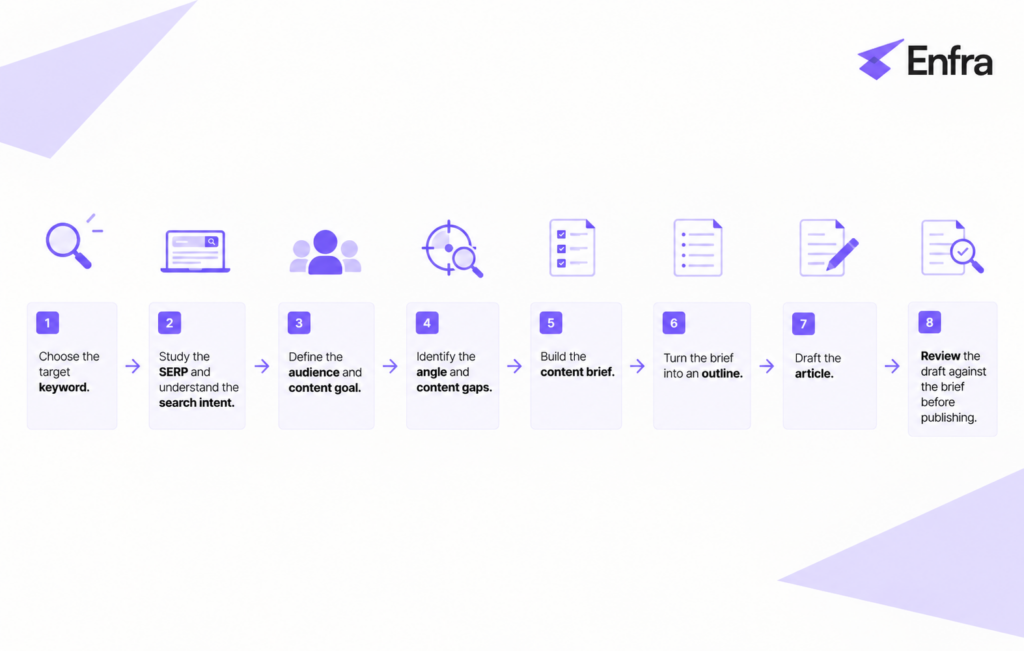
Practical SEO content workflow – from keyword research to publish-ready content
A practical SEO content workflow looks like this:
- Choose the target keyword.
- Study the SERP and understand the search intent.
- Define the audience and content goal.
- Identify the angle and content gaps.
- Build the content brief.
- Turn the brief into an outline.
- Draft the article.
- Review the draft against the brief before publishing.
The time-consuming part isn’t usually writing the outline. It’s everything that happens before it: gathering SERP data, comparing competing pages, identifying gaps, and deciding what the article should do differently.
This is where tools can help.
Enfra helps teams research the SERP, identify content gaps, define an angle, and create research-backed briefs before drafting begins. Once the strategic direction is clear, turning that brief into an outline becomes much simpler.
If you’re building a broader content process, a content audit can also help identify which existing pages deserve attention before you decide what to publish next.
Final Takeaway
A content brief and a content outline aren’t the same thing.
The brief sets the direction. The outline sets the structure.
Use the brief to define the audience, intent, goal, angle, and requirements. Then use the outline to turn those decisions into a logical sequence of sections.
For simple assignments, you may only need one. For competitive SEO content or workflows involving multiple people, using both can make the work easier to assign, draft, and review.
If your team wants to create research-backed briefs faster, start using Enfra or book a demo to see how it can help turn keyword research into a clearer content workflow.
Go From Keyword to Draft With Enfra →
Marketing Engineer at Enfra | Building agentic systems, web applications, and software products.