
Content decay is the gradual loss of rankings, clicks, and relevance for a page that used to perform better in search. It usually happens when information gets outdated, competitors raise the bar, or search intent changes.
The problem rarely starts with a dramatic drop. A page might move from position 3 to position 7. Clicks decline a little each month. The post still brings in traffic, so nobody touches it. By the time anyone notices, it may be contributing far less traffic or leads than it once did.
If you manage a content library, content decay is one of the most common reasons organic traffic stalls. The important question is not simply whether a page is declining. It is why it is declining and whether the right response is a content refresh, a rewrite, or no action at all.
What is content decay?
In SEO, content decay means a page gradually loses search performance over time.
That decline can show up as:
- lower rankings for terms the page used to rank well for
- fewer clicks from search
- weaker click-through rates
- reduced visibility for related queries
- lower relevance compared with newer or stronger competing pages
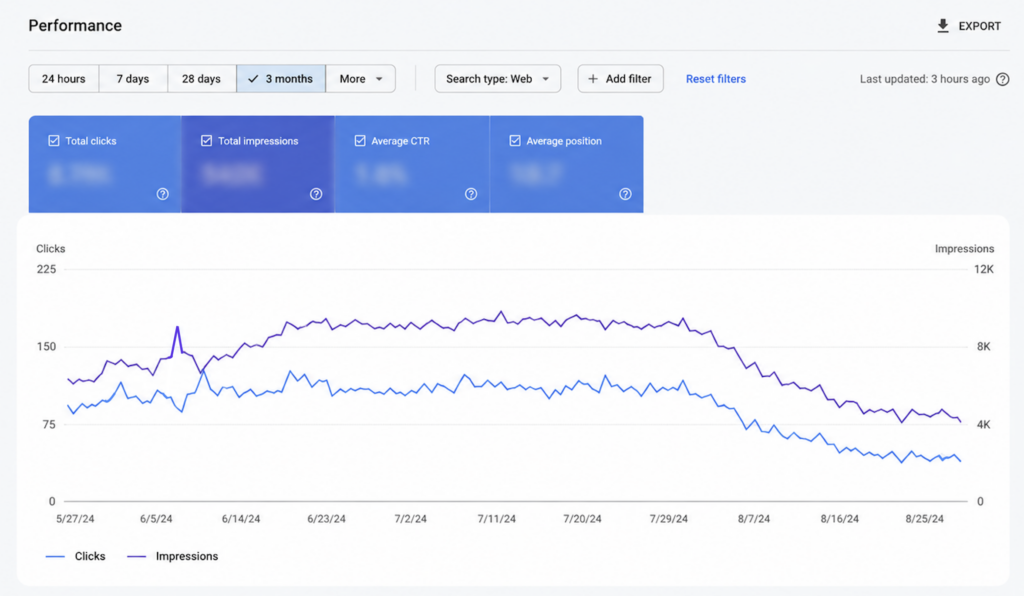
Unlike a sudden drop caused by a technical problem, site migration mistake, or deindexing issue, content decay usually happens in small steps. That makes it easy to miss unless you review page performance regularly.
A quick side note: Enfra’s Page Monitor checks your pages daily, helping you catch technical issues like downtime before they get mistaken for content decay.
Why content decay happens
Most cases of content decay come down to a handful of recurring problems.
Information gets outdated
Pages age.
Statistics become old. Screenshots no longer match the product. Examples reference previous years. Advice that made sense when the article was published may no longer reflect the current search environment.

A guide published in 2023 might still be technically correct in places, but outdated examples and product interfaces can make it less useful than a fresher result.
The competitive standard changes
Sometimes your page does not become worse. Someone else just publishes something better.
Over time, competitors may introduce:
- clearer structure
- more direct answers
- stronger examples
- better coverage of important subtopics
- more useful formatting
A page that once looked complete can start to look thin as the quality and depth of competing results improve.
To improve the overall quality of your content and ensure that it’s competent enough today, you can check out the full content optimization guide. It covers everything from intent alignment and topical coverage to internal linking and content refresh.
Search intent shifts
A query can change without your page changing.
Search results that once favored basic definitions might later lean toward templates, comparisons, examples, or step-by-step guides. If your page still serves the old version of intent, rankings can slide even if the content itself is well written.
A page can be perfectly competent and still lose visibility when the SERP changes around it. And when that happens, it stops being a refresh problem and starts demanding a full rewrite. We have covered also when a rewrite makes more sense in our content refresh post.
The page loses site support
As a site grows, older URLs can become less integrated into its current internal linking structure. New related pages may not link back to them, while newer content receives more contextual links and editorial attention.
In order to avoid such situations, simply ask Enfra to:
Update the internal linking of [post] and make sure to include older as well as newer relevant links in its content.
Internal linking alone rarely causes content decay, but a page that is isolated from the rest of a growing topic cluster can become harder to maintain as a competitive result.
How to spot content decay
The first step is confirming that you are looking at real decline rather than normal fluctuation.
Compare current performance with an earlier period and look for sustained patterns.
Common signs include:
- organic clicks trending down over several months
- rankings slipping from the top 3 into positions 4 to 10
- page-one terms dropping onto page two
- impressions holding steady while CTR falls
- competitors consistently overtaking the page
- related queries disappearing from the page’s keyword footprint
Enfra takes care of all of that and surfaces your highest-value pages that are losing rankings or slipping onto pages 2 and 3, so you can cut through the noise and start prioritizing the right refreshes immediately.

For example, say a post ranked in position 2 for its main keyword and brought in 900 clicks over 90 days. Three months later, it ranks in position 8 and brings in 420 clicks. Now that’s a page which has been a victim of content decay.
If impressions have remained relatively stable, demand for the topic likely still exists. The more likely issue is that the page has lost visibility to competing content, making it a good candidate for a refresh using our content refresh checklist.
Another common pattern is a broad decline across related queries. Instead of losing one keyword, the page gradually loses ground across an entire topic. That often points to problems with freshness, intent match, structure, or coverage.
Content decay vs a normal traffic dip
Not every decline is content decay.
Traffic can fall because of seasonality, changing search demand, short-term SERP volatility, or temporary events. One weak month does not automatically justify a content refresh.
| Signal | Content Decay | Normal Traffic Dip |
|---|---|---|
| Pattern | Gradual, sustained decline over weeks or months | Short-term drop followed by recovery |
| Traffic trend | Keeps trending downward | Fluctuates around a generally stable baseline |
| Keyword rankings | Multiple keywords slowly lose positions | Rankings may dip temporarily, then rebound |
| Affected pages | Often concentrated on older content | Can affect individual pages or the whole site |
| Likely cause | Outdated information, shifting search intent, stronger competitors | Seasonality, algorithm volatility, holidays, temporary SERP changes |
| What to check | Compare performance over 3–6+ months | Compare against the same period and historical patterns |
| Best response | Investigate and refresh the content | Monitor before making major changes or considering a rewrite |
| Example | A post loses 10% of traffic every month for six months | Traffic drops 20% for one week, then returns to normal |
Simple rule: A normal traffic dip is temporary noise. Content decay is a sustained downward trend that doesn’t correct itself.
How to diagnose content decay
Once you suspect a page is decaying, do not start editing immediately.
First determine what changed.
1. Confirm that the decline is real
Start with Search Console and compare the last 90 days with the previous 90 days. This comparison doesn’t have to be manually done by hand. Simply connect Enfra to your Search Console and Google Analytics and ask it to check for:
- clicks
- impressions
- average position
- CTR
Look for sustained movement rather than isolated drops.
If rankings and clicks are both declining, the page likely has a visibility problem. If impressions are stable but CTR is falling, the issue may be how the page appears in search results.
If both clicks and impressions are down, check whether search demand for the topic has declined before assuming the page itself is the problem.
2. Identify what actually changed
Look at the queries connected to the page.
Ask Enfra:
- Which terms lost the most clicks?
- Which terms dropped the most positions?
- Are losses concentrated around one topic?
- Are new queries appearing that suggest a change in search intent?
- Is the decline affecting the entire page or only a specific group of keywords?
This helps distinguish a broad content problem from a narrower issue.
For example, a page losing visibility across dozens of related queries may need a more substantial update. A page holding rankings but losing clicks may need better title and meta copy instead. To map the actions that need to be performed during a content refresh, check out how to refresh old blog posts.
3. Compare the page with the current SERP
Search the main keyword and study what ranks now.
Do not just ask who ranks above you. Ask what kind of result Google is currently preferring.
Look for changes in:
- content format
- search intent
- freshness
- depth
- structure
- examples
- FAQ coverage
- how directly pages answer the query
If the current top results solve the searcher’s problem differently from your page, that difference may explain the decline.
4. Audit the page for specific gaps
Now review the page itself.
Look for:
- outdated facts or references
- stale screenshots and examples
- missing subtopics
- repetitive sections
- weak introductions
- unclear heading structure
- buried answers
- weak internal links
- title and meta copy that no longer stand out
The goal is not to produce a generic list of improvements. Identify the specific reasons this page is struggling. Use our content audit guide to learn what to check for during an audit and spot major gaps in your content.
5. Choose the right response
A declining page does not automatically need a refresh.
You generally have several options:
- Refresh: Update information while keeping the core topic and structure.
- Rewrite: Rebuild the page when the intent, format, or positioning is fundamentally wrong.
- Consolidate: Merge overlapping pages competing for the same topic.
- Redirect or prune: Remove the page when it no longer supports a useful search or business goal.
- Do nothing: Wait when the decline is minor, seasonal, or caused by lower search demand.
This decision should come before editing.
How to fix content decay
The fix should match the cause. Do not apply every possible optimization to every declining page. Check how to refresh old blog posts to learn what targeted actions to perform during one cycle of refresh.
- If the page is outdated, refresh the information. Update:
- old statistics
- year references
- screenshots
- product details
- examples
- source links
This is often the fastest improvement when the core content is still useful but the details make the page feel old.
- If the SERP has changed, rework the intent match
A page may need more than a few updated paragraphs. If the current SERP now favors a different format, restructure the page around what searchers expect. That could mean:
- turning a definition-heavy article into a practical guide
- adding examples where competitors now use them
- introducing comparisons or templates
- moving the main answer higher
- changing the page format entirely
Do not copy competitors mechanically. The point is to understand what the searcher now expects from the query.
- If the page has coverage gaps, add what is missing
Compare your page with the questions and subtopics covered across the current SERP. You might need:
- a missing H2
- a clearer definition
- a stronger practical example
- answers to common objections
- a relevant FAQ
- a better explanation of the core process
The goal is not to make the page longer. It is to make it more complete for the query.
- If rankings are stable but CTR is falling, improve the snippet
If impressions are healthy and average position has not changed much, focus on how the page appears in search. Ask:
- Does the title still match the real intent?
- Does it compete against the current results?
- Does it give searchers a clear reason to click?
- Does the meta description reinforce the value of the page?
A page can lose meaningful traffic without a major ranking drop if competing results look more current or useful.
- If the page is poorly connected, strengthen relevant internal links
Ask Enfra to look for newer and related pages that should naturally link to the declining URL. Also review links from the page itself. Readers should be able to continue to relevant resources without the page becoming an isolated piece of content.
For example, a page about content decay could naturally connect to a content refresh guide, a content refresh checklist, and a guide on how to refresh old blog posts.
Internal links should support the topic and reader journey, not exist simply to add more links.
- Re-index and monitor the result
After making meaningful updates, request indexing if appropriate and track performance over the next 30, 60, and 90 days.
Watch:
- whether important rankings recover
- whether CTR improves
- whether clicks begin trending upward
- whether the page gains visibility for related queries
If a well-targeted update produces no movement, revisit the diagnosis. The problem may require a rewrite, consolidation, or a different content strategy.
When a content refresh is not the right fix
A refresh is useful when the page still targets the right topic and can realistically compete after targeted updates.
It is probably the wrong response when:
- search demand for the topic has collapsed
- the SERP now favors a fundamentally different type of page
- the original page targeted the wrong keyword
- two overlapping pages should be merged
- the page no longer supports a meaningful business goal
For example, if a page once ranked for an informational query but the SERP now heavily favors product pages, adding a few paragraphs will not solve the underlying mismatch.
The better response might be to:
- write a new page
- merge overlapping content
- redirect the weaker URL
- prune the content entirely
Not every declining page deserves a refresh budget. Use our content optimization strategy to decide which ones do.
How to prevent content decay across your site
You cannot prevent every page from losing performance. You can catch problems earlier and make content maintenance more systematic.
- Review important pages regularly: Your highest-value URLs should not sit untouched indefinitely. Create a review cadence (or a task on Zoho Projects) for:
- high-traffic posts
- high-conversion pages
- pages ranking in positions 4 to 15
- core cluster pages supporting important topics
The goal is not to rewrite these pages every quarter. It is to catch declining performance before the traffic loss compounds.
- Monitor topics, not just individual URLs: Pages often weaken as part of a larger cluster. If a major guide begins slipping, check its supporting content too. A cluster-level review can reveal:
- outdated supporting pages
- gaps in coverage
- overlapping content
- weak internal linking
Content optimization gives you a better view of whether one page is failing or whether the entire topic needs attention.
- Use a repeatable review process
The easiest way to miss content decay is to rely on memory. A consistent workflow should help you:
- detect sustained decline
- diagnose what changed
- prioritize pages worth fixing
- choose the right response
- monitor the outcome
That is where Enfra can help. A content decay workflow requires you to spot declining pages, compare them with the current SERP, and prioritize the opportunities worth acting on. Enfra brings those checks into one workflow instead of requiring teams to piece them together manually.
Frequently Asked Questions
What is content decay in SEO?
Content decay in SEO is the gradual loss of rankings, clicks, CTR, and relevance over time. It usually happens when content becomes outdated, competitors improve, or search intent changes.
How do you know if a page has content decay?
Look for a sustained drop in rankings, clicks, CTR, or visibility across related queries. Content decay is usually a long-term decline, not a short traffic dip.
Can content decay be reversed?
Yes, often. If the topic still has demand and the page still fits search intent, targeted updates can help recover lost rankings and traffic.
What causes blog posts to lose rankings over time?
Common causes include outdated information, stronger competitor pages, changing search intent, weak topic coverage, and poor internal linking.
What is the difference between content decay and content refresh?
Content decay is the problem. Content refresh is one possible fix. Once you find the cause, you can decide whether the page needs a refresh, rewrite, consolidation, or no action.
Conclusion
Content decay is normal. Ignoring it is expensive.
Most sites do not lose traffic because every page is bad. They lose it because useful pages age, competitors improve, and gradual declines go unnoticed.
The goal is not to refresh every declining page. It is to catch real decay early, diagnose what changed, and choose the response that actually addresses the problem.
Use Enfra to spot declining pages, compare them against the live SERP, and identify the content opportunities worth turning into action.

Intern at Enfra | Building agentic systems, web applications, and software products.