
An SEO content brief is a document that tells a writer what to create, why it matters, and what the page needs to rank. A good one covers keyword intent, topic coverage, structure, internal links, and the action you want the reader to take.
Most teams know they should use briefs. The problem is that many briefs are either too thin to be useful or so bloated that the writer ignores half of them.
The best SEO content brief sits in the middle. It gives clear direction without turning into a data dump. It helps the writer move faster, reduces rewrites, and improves the odds that the finished page matches what Google already rewards.
If you’re building briefs by hand, the process usually starts with keyword research, SERP review, and a quick pass through your existing site.
But research is only half the job.
You still need to turn it into a brief your writer can use, and many teams already have a format they do not want to rebuild every time. Enfra handles both parts by doing the research and generating the brief in your own structure.

What Is an SEO Content Brief?
An SEO content brief is a working document for a specific page. It gives the writer the inputs needed to produce a piece that fits search intent and supports your business goal.
A general content brief might only cover tone, audience, and messaging. An SEO content brief goes further. It includes the search query, the angle that fits the SERP, the sections the page should cover, and the on-page requirements that matter before publishing.
That does not mean the brief should control every sentence. Its job is to create clarity. The writer still needs room to explain the topic well.
A useful brief answers a few basic questions up front:
- What keyword are we targeting?
- What does the searcher actually want?
- What should this page say that competing pages already cover?
- What should this page add that others miss?
- What action should the reader take next?
Most importantly, a useful brief should reduce the work later during a content refresh. When the original keyword target, intent, structure, and page boundaries are clear from day one, updating the post is faster and usually more effective.
Why SEO Content Briefs Matter
A good brief improves the content before the first draft starts.
Without one, the writer often guesses at intent, depth, and structure. That leads to predictable problems.
- The article drifts off topic.
- Important subtopics get skipped.
- The draft comes back for major revisions.
Then someone on the SEO side has to rebuild the page after the fact.
A solid brief prevents most of that.
It also helps the rest of the workflow. Editors know what to check. Strategists know what they asked for. Designers know where screenshots or charts belong. If you already run a content audit, briefs also help you standardize what “good” looks like across the pages you publish next.
Spending more time on the brief upfront also makes later updates easier. If the page is built on the right keyword, intent, structure, and internal linking plan, a future content refresh is much simpler.
There is another reason briefs matter now. Ranking is no longer just about dropping the right phrase into the page. Google looks for stronger intent match, better topical coverage, and clearer answers. In many SERPs, Google now summarizes answers before the organic listings, so the page needs to be structured clearly enough to earn clicks and clear enough to be cited.
A strong brief helps set those requirements before writing starts. That means your outline, examples, and FAQ choices matter more than they used to.
What to Include in an SEO Content Brief
A strong SEO content brief does not need dozens of sections. It needs the right ones.
Primary keyword and search intent
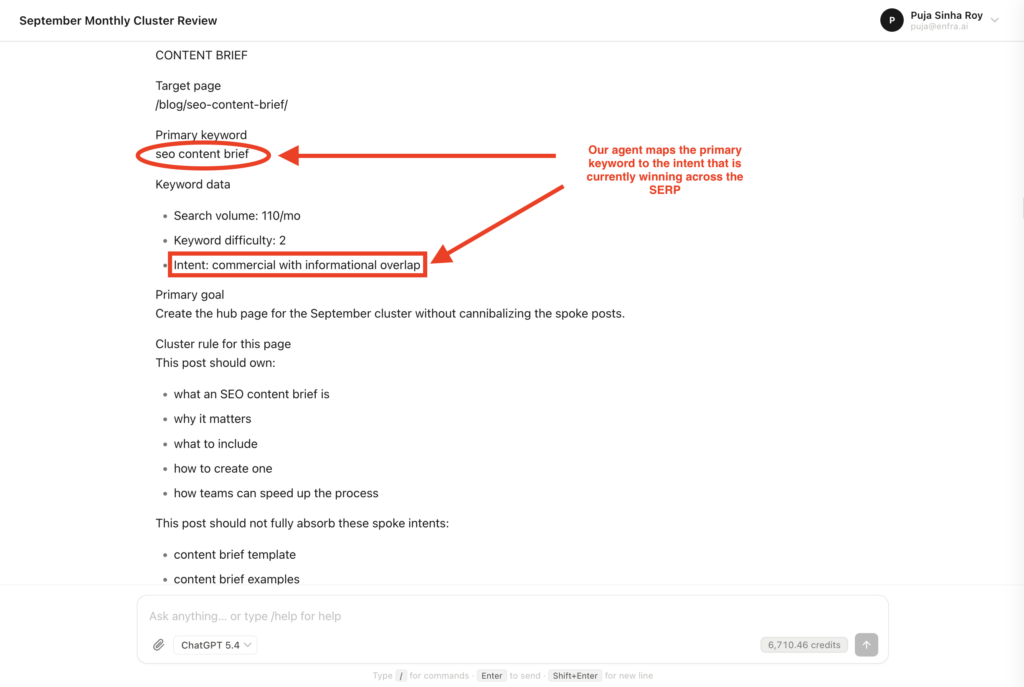
Start with the main keyword. Then define the intent behind it. For more on choosing the right terms and matching them to search intent, read our guide on how to choose the right keywords for your SaaS blog posts.
This matters because two pages can target similar phrases and still need completely different structures. A how-to query needs a process. A comparison query needs clear evaluation criteria. A commercial query usually needs stronger product context and a clearer CTA.
Do not stop at “informational” or “commercial.” Add one short line about what the reader is trying to get done.
Example:
- Primary keyword: seo content brief
- Intent: commercial with informational overlap
- Reader goal: learn how to build a better brief and find a faster way to do it
Audience and problem to solve
Your writer needs to know who the page is for. If that is still vague internally, start by defining your target audience.
Then go deeper with our niche keyword research guide to connect that audience to the terms they actually search.
“Marketers” is usually too broad. A better audience note might be:
- in-house SEO manager at a SaaS company
- content lead at an agency
- founder running SEO without a full team
Then define the problem clearly. In this case, the problem is not “they need content.” It is “they need a better way to brief writers so the final page ranks and requires fewer revisions.”
That changes the article.
Article angle and goal

This is where many briefs fall apart. They list the topic but never explain the angle.
A content brief about SEO content briefs can take several directions:
- definition-first beginner guide
- process-heavy how-to
- template-focused page
- examples page
- software-led workflow page
You need to pick one.
For SaaS teams, that choice should do more than match the keyword. The brief should also map search intent to business value and show where the product fits naturally in the page. Our SaaS SEO product-led growth guide goes deeper on that.
Recommended title, URL, and metadata
The brief should include a working title, URL slug, meta title, and meta description.
This does two things. First, it tells the writer what promise the page is making. Second, it keeps the whole team aligned on the page’s search target.
You can revise these later when you’re refreshing the post, but putting them in the brief early helps everyone stay on track.
Heading structure and must-cover topics

This is the core of the brief.
The writer should not have to guess which sections matter. A useful outline shows:
- the H2s and H3s
- what each section should cover
- where a section should stay short
- where the writer should go deeper
This is where live SERP review matters most. If the top-ranking pages all explain the same core ideas, those are table stakes. If they skip something useful, that may be your chance to differentiate.
If you’re working on broader on-page performance, this is also where your content optimization strategy starts to become practical rather than theoretical.
Data to guide the target
Data belongs in the brief because it helps you set expectations before publishing. A strong brief should include the core keyword data tied to the target page:
- search volume
- keyword difficulty
- paid competition signal
- CPC range where relevant
That does not mean paid competition tells you how hard organic ranking will be. It does not. But it still helps you understand how commercially valuable a term may be.
This kind of data gives the writer and strategist a clearer target before the post goes live. It helps answer simple questions such as:
- Is this term worth a full article?
- Should the angle be broader or narrower?
- Is this a realistic target for this site right now?
- Does the keyword suggest business value or just traffic?
The brief should translate the data into direction. Raw numbers alone are not enough.
Internal links and CTA
Internal links should not be an afterthought.
Your brief should suggest a few relevant pages to link to so the writer knows what supporting content already exists. This helps the article fit into your broader site structure and keeps readers moving.
For Enfra, that might include pages related to content optimization, keyword research, or product workflows explained in the blog.
The brief should also state the CTA. Not just “add CTA,” but the actual next step you want the page to support.
Sources, examples, and visual notes
Good briefs make the page easier to build, not just easier to optimize.
If the writer needs examples, case framing, screenshots, or third-party references, note that before drafting begins. This is especially useful when the article needs product visuals or process screenshots.
A short note like this goes a long way:
- include one compact fill-in template block
- include 2 product screenshots showing research and brief generation
- add one simple table for comparison
You can check out our product update posts on Enfra’s Page Monitor feature or our Zoho Projects integration to see exactly how to fit in process screenshots as visuals into your blog posts.
A strong brief should also make clear where the page fits in the wider cluster. When nearby topics overlap, a hub-and-spoke structure helps you decide which page should own the main topic and which supporting pages should cover narrower angles.
If you do not define those boundaries before publishing, you risk overlapping pages competing for the same query. Clear scope upfront makes the page easier to position, easier to refresh later, and easier to link internally as related posts go live.
How to Create an SEO Content Brief Step by Step
You do not need a complicated system. You need a repeatable one.

Start with the live SERP
Search the target keyword and review what Google is already ranking.
Look at the titles first. They tell you how the market frames the query. Then check the top pages for structure, depth, and the kind of examples they use.
Ask:
- Are these pages mostly how-to guides?
- Are they beginner pages or operator pages?
- Do they focus on process, templates, or theory?
- What subtopics show up again and again?
This gives you the shape of the page before you write a single heading.

Identify the dominant intent
This step sounds obvious, but it is often skipped.
A keyword may look informational on the surface but still have strong commercial intent. That is true for many SEO workflow terms. People want to learn the process, but they are also evaluating tools or services that can help them do it faster.
If you miss that, the page can feel off. It may educate well but fail to convert. Or it may push too hard and fail to rank.
The brief should state the dominant intent in plain language so the writer knows what balance to strike.
Review what top-ranking pages cover

Next, map the common topics across the top results.
You do not need a giant spreadsheet for every article, but you do need a clear view of what keeps showing up. For this topic, common sections include:
- what a content brief is
- why it matters
- what to include
- how to create one
That tells you the baseline.
Then look at how well those sections are handled. Some pages cover the basics but stay generic. Others explain the process but bury the practical details.
This is where you start to find your opening.
Spot missing angles and weak spots
The goal is not to copy the SERP. It is to meet the SERP and improve on it.
Maybe competitors define the term well but do not explain how to turn SERP findings into an outline. Maybe they give a checklist but not a clear process. Maybe they cover writers’ needs but ignore conversion goals and internal linking.
Those gaps belong in your brief.
For this topic, the weak spot across many pages is that they explain what belongs in a brief, but not how to build one from live search evidence without wasting time.
That is where Enfra has a natural angle.
Build the outline
Once you understand the SERP, outline the page.
This is where most of the real briefing happens. The outline should not just list section names. It should explain what each section needs to do.
For example:
- define the term quickly
- explain why bad briefs fail
- show the required components
- walk through a step-by-step process
- keep the compact template short so it does not replace the dedicated template page
- finish with practical workflow advice and a CTA
The writer should be able to start from this outline without a follow-up call.
Add SEO requirements without overwhelming the writer
This is where restraint matters. Include what the writer needs:
- primary keyword
- secondary terms
- word count range
- internal links
- meta guidance
- CTA
- sections that must include examples or visuals
Do not flood the brief with every keyword variation you found. Do not paste huge raw exports into the document. If the writer needs interpretation to use the brief, the brief is not doing its job.
A strong brief simplifies. It should give the writer exactly what they need in a format they can use right away. That is why format flexibility matters, and why we considered it in our review of the best content optimization tools.
Add examples, screenshots, and conversion guidance
If the page needs visuals, say exactly where they should go.
If the page needs a product mention, show where it fits naturally. In this article, Enfra belongs in the workflow and efficiency discussion, not in every other paragraph.
If you want a conversion-focused page, give the writer the goal:
- signups
- demo requests
- deeper blog engagement
- product page visits
That makes the CTA more useful and less forced.
Review before handoff
Read the brief once before you send it.
You are checking for a few simple things:
- Is the angle clear?
- Is the intent stated clearly?
- Does the outline make sense?
- Are the internal links relevant?
- Is the CTA defined?
- Have you protected nearby spoke topics from being absorbed into this page?
That last point matters more than many teams realize. If you want a cluster to work, the hub page needs to leave room for support pages to exist.
A strong brief also makes future internal linking easier. When related posts are published later, the structure and topic boundaries are already clear. That makes it much easier to add links naturally during a content refresh procedure once those pages are live.
A Simple SEO Content Brief Template
This is a compact version you can use right away.
Search intent:
Audience:
Reader problem:
Article goal:
Working title:
URL slug:
Meta title:
Meta description:
Word count target:
Required sections:
Must-answer questions:
Internal links to include:
Sources or references:
Visual requirements:
CTA:
That is enough for a useful brief.
If you need a full reusable framework for different page types, build that as its own document in your unique content optimization strategy. This page is not trying to replace a full template library. It is showing what the essentials look like.
Common SEO Content Brief Mistakes
Most weak briefs fail in predictable ways.
- They list keywords but do not explain intent
- They copy competitor headings without adding judgment
- They tell the writer what topic to cover but not what problem to solve
- They dump raw SEO data into the doc and call it a brief
- They forget internal links
- They skip the CTA
- They never mention examples, screenshots, or proof points
- They try to cover every related topic so deeply that nearby pages lose their reason to exist
That last mistake is common in cluster work. A hub page should be broad enough to earn the head term, but not so broad that every spoke turns into duplicate intent.
How to Make the Briefing Process Faster
Manual briefing takes time for a reason. Good research is real work.
You need to review the SERP, identify intent, compare top pages, pull related questions, map internal links, and turn all of that into something a writer can actually use. None of those steps are hard on their own. The problem is the repetition.
That is where automation helps.
The wrong kind of automation gives you a template and asks you to fill in the hard parts yourself. The better kind does the research first, then turns it into a usable output.
That is the point of Enfra. It does the work, not just the reporting. It can read the live SERP, check the likely intent, pull in your brand context from the knowledge base, and suggest internal links based on your site structure. Instead of stitching all of that together by hand, you start with a brief that is already close to writer-ready.

Content Brief vs Outline
These are not the same thing.
A content brief is the full instruction set for the page. An outline is just the structure.
Here is the short version:
| Item | What it does |
|---|---|
| Content brief | Defines keyword, intent, audience, angle, SEO requirements, links, visuals, CTA, and the outline |
| Outline | Organizes the sections and subsections of the page |
If all you hand the writer is an outline, they still have to guess at the strategy. If all you hand them is a list of SEO notes, they still have to guess at the structure.
They need both, but the outline sits inside the brief.
Frequently Asked Questions
What is an SEO content brief?
An SEO content brief is a document that gives a writer the strategy and requirements for a page that needs to rank. It usually includes the target keyword, search intent, recommended outline, internal links, and CTA.
What should an SEO content brief include?
A strong SEO content brief should include the primary keyword, supporting terms, search intent, audience, article goal, structure, internal links, and conversion goal. It should also note any required examples, references, or visuals.
Is there a difference between an SEO brief and a general content brief?
Yes. An SEO brief is built around ranking goals, search intent, and topic coverage, while a general content brief may focus more on messaging, tone, and editorial direction.
Can I use an SEO content brief template for every post?
A template helps, but it should not be used blindly. A good SEO content brief template gives you structure, but each brief still needs to reflect the keyword, search intent, SERP, and goal of the specific page.
Can AI help create an SEO content brief?
Yes, if it starts with real research and follows your site context. AI can help with SERP review, topic grouping, and structure, but the final SEO content brief still needs judgment around page scope, business value, and product fit.
Conclusion
A strong SEO content brief gives the writer clarity before drafting begins. That usually leads to better structure, optimized content, and fewer rounds of revision.
The core idea is simple. Do the thinking early. Define the intent, angle, structure, links, and CTA before the page is written. That makes the final content stronger and the workflow faster.
Run your next SEO content brief in Enfra →

Intern at Enfra | Building agentic systems, web applications, and software products.